Tag Archives: solutions

Resilience Soup

Watching ‘The Island with Bear Grylls’, it appears that apathy caused by culture shock can lead seamlessly to exhaustion from lack of food calories. Part of a Resilience Plan is to keep a small store of tinned and dried supplies. I recommend keeping enough for three weeks, if you have the space.

Inspired to inspect my own collection, I found it was a bit haphazard and resolved to organise it. Counting calories and working out recipes…. I’ll have to write another book.

The stores have to be rotated as sell by dates are reached. Check through them every three months, take out anything that needs used before the next check, rearrange and restock. Never store food you don’t like. Storage conditions are often far from ideal; lofts suffer from stifling summer heat and freezing winters. You couldn’t store butter, for example.

If you ever need to rely on your stores, it’s useful to do some menu planning. Here’s one recipe..

Resilient Lentil Soup

A large pan. This recipe is easier to make in larger amounts. A tablespoon of cooking oil, some tamari (soy sauce). If you have any fresh meat or onion type vegetables to add, chop them up and lightly fry them.

If you are lucky, you may have some stock; otherwise add hot water and a couple of stock cubes. Add about four ounces [112g] of dried red lentils. Don’t pre-soak them.

How much liquid? Depends how many people you want to feed; this recipe is enough to fill four bowls. Remember the lentils will soak up some of it. If you have any root vegetables, put them in now. Grated carrot is nice.

Stir. Bring it to a low boil, then turn the heat right down and let it simmer. Mind it doesn’t stick; pans with thick bottoms are best for this work. Stir in four teaspoons of instant gravy mix and a quarter 130g tube of tomato puree. Keep an eye on the sticking as the soup thickens. You can add more water at any point.

Add any green leafy veg, shredded, just before the end. The soup is done when the lentils are soft, but can be kept simmering to wait for people for as long as you care to keep stirring it.

This soup really needs to be kept in a cold place to last over two meals, so it’s best made fresh and left overs eaten early the next day. Without the added fresh food, this recipe provides an unimpressive 550 calories* between four. If you’re completely unable to access any other ingredients, increase the lentils.
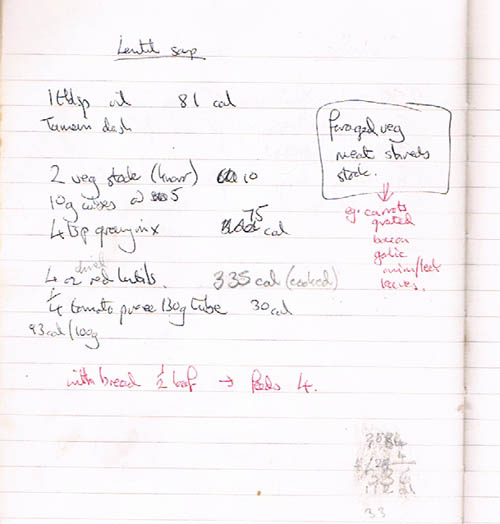
lentil soup calories
*all calculations are strictly back-of-the -envelope

However, what of your neighbours who don’t have stores? Remember, freezers depend on electricity. Could they help you forage to add to the meal? Bacon goes very well with this recipe; it may be available after less thoroughly preserved meats have spoiled.

A basic soup provides an expandable framework for a variety of fresh food.

Resilience.

There’s quite a lot to it.
International Downshifting Week

This week, April 20th – 26th, is International Downshifting Week.

“InterNational Downshifting Week is a non-profit awareness campaign designed to help you slow down your pace, lean towards the green and get a better handle on the work/life balance in favour of life.

It was founded in 2003 by contented downshifter Tracey West, who believes a little downshifting can have a powerful impact on your physical health, your mental well-being, your relationships with colleagues, family and friends; it can even improve your sex life.”

Find out more here.


Shop Local for Xmas

It’s beginning to seep into national awareness that independent, locally based businesses might serve their communities better than identikit chain stores with obscure agendas.

With the destructive competition these small enterprises face from multinationals, the few that still populate the High Street need your support. It’s estimated that around £40 billion will be spent on Xmas in the UK this year; over £750 per household.

Spent locally, remaining in your area instead of instantly vanishing into a remote Head Office, this money could bring about a serious increase in prosperity.

Take a long tea break to think about this, and plan your holiday spending. Shopping in the scattered local outlets will take longer than a trolley dash. Spread it over a few weeks. Be organised so you don’t buy something twice in the last minute rush.

Set a budget for presents. See what you can find at craft fairs. Socks, especially good hand made ones, are underrated. Bath products are often welcome.  Of course you’ll be able to buy more industrially produced items for the same money. Quality is the point here. It’s a gift; it’s the thought that counts not the weight.

Traditional crafts are struggling to stay alive, despite their key role in a resilient society. The few people who persevere have to price their goods at the luxury end of the market to compete with factories. They need your custom more than the supermarkets do, and give far more back. Choose your loyalties.

Half of the total Xmas spend is on gifts. In Somerset alone, this comes to over £80 million, the same as a quarter of the annual County budget.  Another third is spent on food and drink.

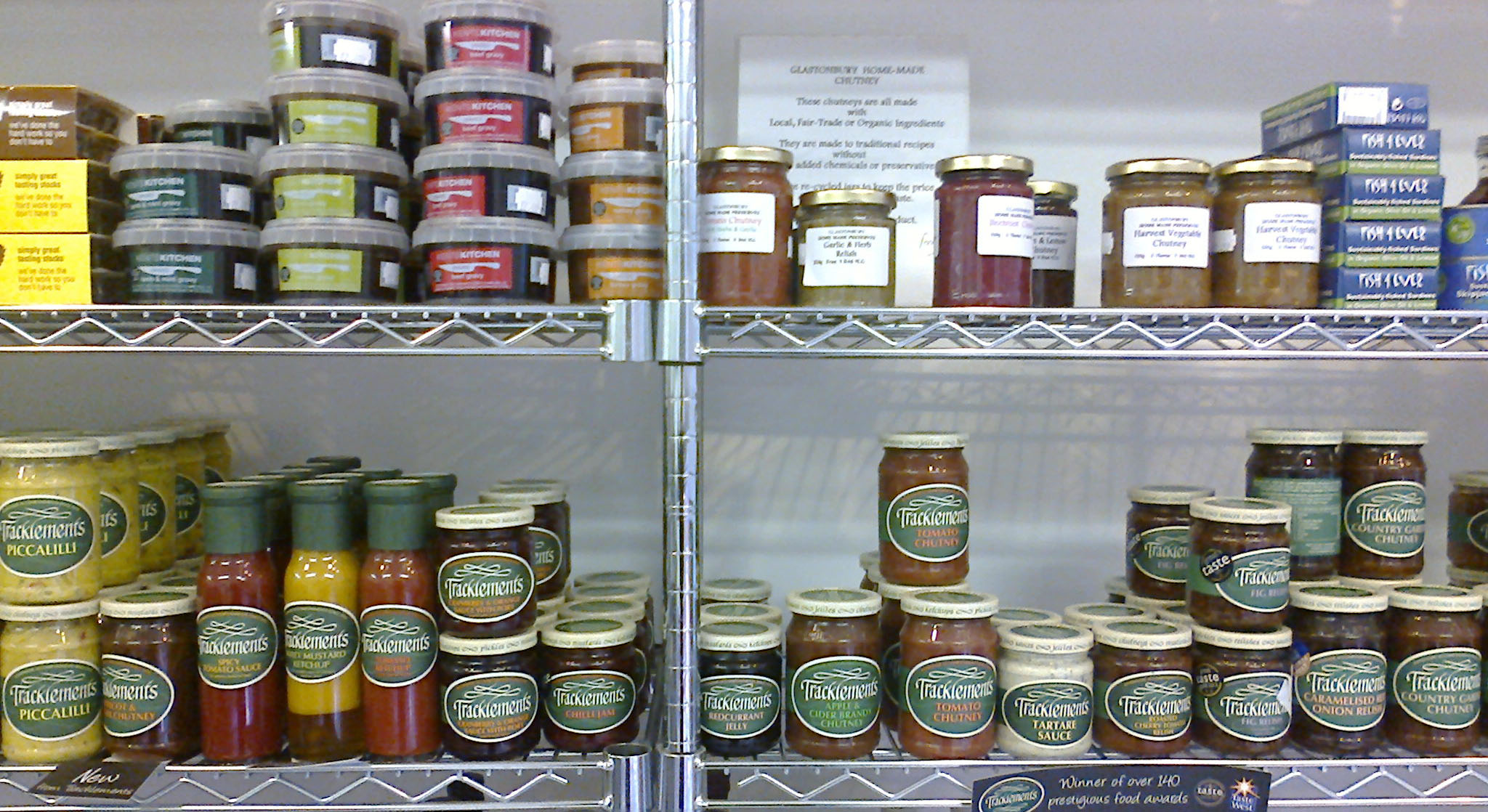
Write a shopping list. There’s plenty of food you could buy well in advance. Farm shops often sell chutneys, jams and pickles. Xmas cakes keep for weeks and are often on sale at markets. Consider making your own mince pies.

The best way to buy your Xmas dinner is to order fresh locally reared organic meat from the independent butcher. If you’ve never done this before, consider there may be a bit of a queue on collection day. Bring an umbrella, a newspaper, be prepared to chat to people, live a little slower.

Spend your Xmas surrounded by food, drink and gifts which that have meaning, not just labels. Start planning now!

local craft shop
Buy craft materials for friends at shops like Glastonbury’s Over the Moon
Stevens butchers on Glastonbury High Street
and while you’re in the High Street, check out the more exotic preserves at Steven’s Butchers


How to use a Spider to braid cord

for the people I met on my travels this summer

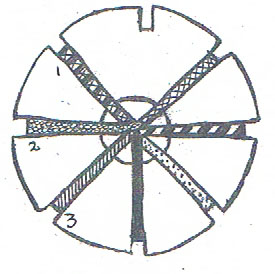
Find some thick card which does not crease easily, yet isn’t too thick to cut. A scrap of mounting board is ideal. Draw a circle about 9 cm across and cut it out. Divide the circumference into 8 sections of roughly equal size. Cut a thin notch, no more than 1 cm long, along each dividing line. Around the centre of your circle, cut out a hole about 1 cm across.

This is a spider.

Cut seven equal lengths of wool, ribbon or thread and knot them together at one end. Push the knotted end through the hole in the spider and lay the threads on top.

preparing the spider for braiding cord

Slot each thread into one of the notches around the edge. The notch should grip the thread quite tightly. There will be an empty notch. Hold the spider so that this is at the top.

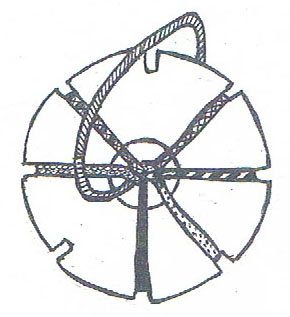
Count three threads to the left. Take the third thread and lift it over the first two, slotting it  into the empty notch.

taking the third thread from the left across the other two and into the empty notch

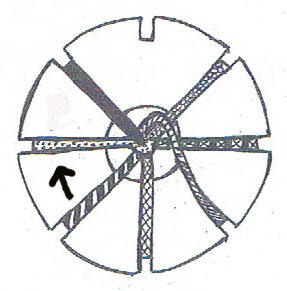
Turn the spider clockwise so that the new empty notch is now at the top. Repeat the process, lifting the third thread to the left over the other two. Your cord will start to form in the centre.

spider 3 v2

Keep the braiding firm but not overtight.

As you work, the loose ends waiting to be braided get tangled. Separate them every so often. This limits the length of your starter thread to about two arms’ length, but once you get the hang of braiding, you can splice new lengths in. Do these one at a time to avoid unsightly lumps, and to maintain the cord strength.

Once you have had some practise and know what you need this tool to do, you could cut a longer lasting version from thin plywood. Try making cord from wild grasses, braid heavy duty cables from thin rope using a much larger spider.

The use of braided wicks was a key development in candle technology. Can you replicate this process? Could you invent a simple machine to braid cord? Why might you need to?

New ways of thinking

A statement with very important implications and data back up

“The irregularity of investment returns stirs up wealth differences while transactions of all types between people tend to wipe them out.”

and a confrontational rant

” Don’t pretend you’re too far out the system to vote and then get your food from a supermarket. The word for that is ‘hypocrite’ not ‘rebel’ ”

Which got more response?

Which needs to get more response?

A community transport hub

Imagine not a simple bus shelter, but a small building in every village, at every key location in towns and cities. It’s furnished with cushioned chairs, magazines and a water dispenser. The place is kept clean and maintained by a rota of local people. The solar panels on the roof provide power for lighting – including the ‘Stop’ light outside so that the bus driver knows there are passengers to pick up.

Buses come every hour at most and there is thoughtful scheduling of connections. No matter how long or awkward your journey, you never have to wait more than an hour to catch your next link. Fares are cheap. A day pass costs scarcely more than a single journey. A conductor helps you on with your luggage, and can advise you about other services.

There are lockers in the building, operated by tokens or small coins, where you can leave your shopping and go for lunch. Or lock your bicycle to the racks outside and store your wet weather gear to catch the bus for the trip to work in town.

Shoppers are transported directly into the town centres. The independent shops do well, local produce sells and is encouraged, money stays within the community. Many new jobs are created.

There is a community notice board at the hub, with news of events, official meetings, items for sale or wanted. At busy times, a local business brings a small mobile stand for newspapers and refreshments. There is a roll-out awning on one side of the building to protect a weekly produce stand, or a sale in aid of some project.

The buses are partly run on electricity, and there is a charging point close to the hub, perhaps powered by the community windmill. The surplus is available to local disabled people to charge their small electric cars.

A network of bicycle tracks links these hubs. They often use different, traffic free routes with the occasional shelter along them in case of heavy rain. Footpaths sometimes follow these routes, sometimes diverge into wilder, more scenic areas.

Where does the land come from for these hub buildings?

Car parks.

© Elizabeth J Walker 2014

What do you need from transport?

You need to get yourself, possibly your family of young children, an elderly relative, maybe a dog, from here to there. You don’t want it to be prohibitively expensive, you don’t want to have to wait around in the rain or lug heavy bags a long way.

A car was the answer! Everybody got one, and then two, even three!

Then you begin to fall out with your neighbours over parking. The cost of running a car goes up by the day. You are getting unfit because you drive everywhere, so you consider a bicycle. The roads are too dangerous because they are full of cars. You think about the bus, but they are costly, infrequent and often unreliable or non-existent in rural areas.

Depending on your car means depending on oil, mainly from other countries. The news is full of the trouble and deadly conflict caused by arguments over who controls these fuel resources. You hear of the vast areas of pollution surrounding extraction sites.

Always the price you pay for fuel rises, and a disruption of supplies brings your entire lifestyle to a stop – this is not resilient!

We are addicted to the use of oil. It will not be easy to cut back, but it must be done. Local initiatives are the key to encouraging government and business to get involved. They will not do so without public pressure, both political and by the use of your spending power.

Change is happening slowly, but it needs more people to engage with the process. Here’s a couple of good places to start.

The Urban Walking route planner gives you a route map between any two points, including your journey time, calorie burn, step count and carbon saving. It’s quick, free, healthy and green!

Sustrans is a charity enabling people to travel by foot, bike or public transport for more of the journeys we make every day. They work with families, communities, policy-makers and partner organisations so that people are able to choose healthier, cleaner and cheaper journeys, with better places and spaces to move through and live in.


© Elizabeth J Walker 2014

Willows and Flooding

The Somerset Levels have grown willow since prehistoric times; the remains of a basket were found by the Glastonbury Lake Village. Willow trees are plentiful in marshlands as they can thrive in waterlogged soils. Their long flexible shoots have many uses, including furniture, fencing and fish traps.

Traditional methods of pruning, or pollarding, cut the tree back to its main trunk. A shock of long straight withies springs out from the cut, and can be harvested. The trees are quite tall and have a distinctive knobby shape. Pollarded trees need to be maintained, which is difficult when the trimmings have no value.

Many modern willow beds are coppiced. The growth is cut back, even to ground level, every couple of years. Material which could be used for craft products is burned as biomass fuel. Willow beds established by grant funding have no budget for upkeep.

The Levels grew nearly 40 square kilometres of willow in 1930, but this has declined to a mere 1.4, mainly due to replacing basketry with disposable bags and packaging. Garden furniture is made from imported, oil based plastic and most people would struggle to recognise a fish trap.

Planting willow around the banks of rivers stabilises them, and can be extended into a buffer zone. This would aid the retention of water in a managed flood plain, protecting urban land further downstream. Willow is particularly good at removing toxins from contaminated land. It could be planted straight after a major flood, but it won’t be, as no-one can earn a living from it.

The decline of willow production needs to be reversed by creating a market.

The storms that often accompany flooding have wreaked havoc on garden fencing. Tall solid panels which resist the wind have fallen in heaps. Woven willow fencing allows the light and air through, while affording privacy.

Order some from a local willow craftsperson. It will be more expensive than cheap imported products. If you have a garden and a fence, though, it makes sense to support the farmers upstream who are preventing them flooding. Think about what else you could replace with locally sourced willow.

Alternatively, find a project which needs help with coppicing and negotiate your own materials.  Carymoor Environment Trust in Somerset have a volunteers’ day every Tuesday.

willow crafts


Driving in the Water Margins

Here on the levels in Somerset between the sea and the high ground we’re used to seeing the water. Driving between towns, the fields are shimmering mirrors, traced with sunken hedges, populated by opportunistic swans. The main roads are edged by dark puddles, threatening to merge over the white line with every fresh downpour.

Villages hugging the tiny ridges of high ground out in the marshlands are often cut off. Farm tractors become informal delivery vans and buses. Rows of willow trees, planted so that people can see where the road was, come into their own. The river lurks just over a low bank.

The network of narrow lanes across country are under water in many places, especially at the crossroads and gateways where you could have turned around. If you come upon one flooded section, chances are there are more ahead. It’s unwise to use these lanes as a short cut.

Towns are linked by single main roads. An incident on one of these could involve you in a twenty mile diversion just to get back from the shops. If that route then becomes blocked – easy enough with the high winds and dangerous conditions – hundreds of people could become stranded for hours.

Keep at least half a tank of fuel, even for local journeys. Carry waterproofs, wellies and a drink of water in your car. Make sure your mobile phone is charged.

Shop with a list and bring in extra long life food. Try to avoid going out at all in heavy rain. Start using all those ready meals in the freezer; if your electricity goes, they will be a write off anyway.

Night time is the most dangerous. Plan to stay in, invite neighbours round, play cards or games, learn to knit. Spending all your evenings slumped in front of the TV will soon give you cabin fever!

Driving through flood water is unwise, especially if you are on your own. You can’t see how deep it is, if the road has been washed away underneath, if there are any obstructions ahead. Your electrics may get damaged.

Don’t change gears but drive slowly and steadily. If your engine cuts out, it may have got water in it. Trying to restart it might destroy it.

Even six inches of fast moving water can sweep you off your feet, and not much more can move your car. If you become trapped in a flood, call for help at once. Don’t panic and think very carefully about your escape route.

Resilience is about adaptation. Change your behaviour in response to the environment. Go out as little as possible and make every journey count. Even if you’re not directly affected by flooding, you could still be caught up in a diversion as police try to clear another area. Your presence on the road is one more factor for the emergency services to take into account, so don’t waste it.


Roast dinner and leftover stew

You’ll find that collecting vegetables from the garden adds to the preparation time for a large meal. They need to be dug up, washed and trimmed. You can economise on effort by cooking more than you need and adding the surplus to a stew the next day.

Buy a bird or joint for a roast dinner. You can afford organic free range, as you’re going to be able to get up to twelve adult meals from under £10 worth. While it is cooking, use the oven to roast trays of potatoes, onions, parsnips, carrots and squash – whatever you have available. Keep enough room for a tray of Yorkshire puddings to go in later.

Timing is crucial. Wash all the vegetables. The meat will take longest to cook, so put it in first. Read some recipes for more exact times. After the meat has cooked for awhile, the roast potatoes are next. Put them on the shelf above the meat until they start to brown when you can move them lower. If you get fed up waiting for this to happen, you might be able to finish them off under the grill. Don’t forget they are there.

Make a Yorkshire pudding mix using one egg, two tablespoons of plain flour and four fluid ounces of milk. It needs to stand for at least half an hour before cooking. Longer is better.

Prepare the vegetables for roasting. They can go in when the potatoes are getting soft nearly to the middle. You could move the meat down a shelf now. Do use hand protection when moving hot oven shelves, always take the trays off and set them on a heat proof surface first, and be careful of hot oil.

Cut up some cauliflower, shred brassica leaves, spinach or chard ready for steaming on the hob. Take your Yorkshire pudding trays, add a teaspoon of oil in the bottom of each and put the empty tray near the top of the oven for the oil to heat up.

Check the progress of the other things in the oven. The meat should be nearly ready to take out and the vegetables almost edible. If not, this is a good time to tidy up. When everything else is up to speed, take out the trays and carefully add a couple of tablespoons of the batter mix to each. The above amounts should make six, just share it around, they don’t need to be very full. Return them to the oven, near the top. Start steaming the vegetables.

The idea is to smother everyone’s plate with vegetables so that they do not notice there is only a small piece of meat each. The Yorkshires are for filler, and if you can make a thick gravy using the juices from the roasting dish, so much the better.

Hide the rest of the meat, or otherwise ensure no-one is going for seconds or midnight raids. There should be a mixture of vegetables left over. Keep these for the next day’s cooking, when you will be making leftover stew, possibly with dumplings. If you bought a bird, you can make a stock with the carcass and use this as a base for a broth on the third day.

An expanded version of this strategy, along with recipes for vegetables, has been included in ‘Recipes for Resilience’, to be published in 2018.