All posts by Elizabeth J Walker

Unknown's avatar

About Elizabeth J Walker

An expert in practical resilience and survival skills retires. She writes a story set between this world and another. It gains a life of its own, leading her on an epic journey. Now you can read how this begins in 'Strange Landscapes - Volume One; Leitha and the Fox'.

Not too late to grow food!

The rain has finally eased off in Somerset and the sun even comes out occasionally. The soil is saturated and the legions of molluscs are emerging from their winter caves. Yet the intrepid gardener must make the best of it and see what can be grown.

Adding some dry compost or soil improver before sowing will help to soak up the water in seed beds. Circling these with a ring of dry bran discourage slugs. Try and avoid resorting to chemical pellets, though the neighbourhood cats have probably put paid to any natural predators.

If you have windowsill or greenhouse space, start some plants off there. Don’t put them all out at once. Grow enough to have a reserve, and be careful to harden them off before planting out. Healthy plants are the best defence against pests.

It won’t be a good year for the more delicate vegetables. Potatoes can hold their own in most circumstances. Plant them around the edges. The hairy leaves of pumpkins and squash are also resistant to attack, though it is too early for these to go outside. Sow a catch crop of radish or cress in the large patch of empty space they will need later.

Remember to feed your soil. The liquid fertiliser you made last year from comfrey and nettle leaves will do just fine. Peas and beans make their own nitrogen, however, so don’t overdo it around them. Avoid treading on the soil to keep its structure intact. Keep to marked paths in large beds. Once the soil is properly aerated, the difference is obvious.

Brassicas will need constant attention this year. They’re worth some trouble for their winter leaves and the delicious sprouting heads in the following Spring. However, if they can survive the mollusc army, the caterpillars will be next. Planting nasturtiums in the same bed distracts these creatures, who will munch on them by preference.

Leeks do better in clay soil than onions. They develop slowly but steadily, requiring little maintenance apart from weeding. Root vegetables prefer sandier soil, which you can mix yourself to cultivate carrots in pots, or the larger parsnips in tyres.

Finally, don’t forget to sow some borage and marigold. The colourful flowers attract bees and make the vegetable patch look decorative. Happy gardening!

© Elizabeth J Walker 2014
 

A community transport hub

Imagine not a simple bus shelter, but a small building in every village, at every key location in towns and cities. It’s furnished with cushioned chairs, magazines and a water dispenser. The place is kept clean and maintained by a rota of local people. The solar panels on the roof provide power for lighting – including the ‘Stop’ light outside so that the bus driver knows there are passengers to pick up.

Buses come every hour at most and there is thoughtful scheduling of connections. No matter how long or awkward your journey, you never have to wait more than an hour to catch your next link. Fares are cheap. A day pass costs scarcely more than a single journey. A conductor helps you on with your luggage, and can advise you about other services.

There are lockers in the building, operated by tokens or small coins, where you can leave your shopping and go for lunch. Or lock your bicycle to the racks outside and store your wet weather gear to catch the bus for the trip to work in town.

Shoppers are transported directly into the town centres. The independent shops do well, local produce sells and is encouraged, money stays within the community. Many new jobs are created.

There is a community notice board at the hub, with news of events, official meetings, items for sale or wanted. At busy times, a local business brings a small mobile stand for newspapers and refreshments. There is a roll-out awning on one side of the building to protect a weekly produce stand, or a sale in aid of some project.

The buses are partly run on electricity, and there is a charging point close to the hub, perhaps powered by the community windmill. The surplus is available to local disabled people to charge their small electric cars.

A network of bicycle tracks links these hubs. They often use different, traffic free routes with the occasional shelter along them in case of heavy rain. Footpaths sometimes follow these routes, sometimes diverge into wilder, more scenic areas.

Where does the land come from for these hub buildings?

Car parks.

© Elizabeth J Walker 2014

What do you need from transport?

You need to get yourself, possibly your family of young children, an elderly relative, maybe a dog, from here to there. You don’t want it to be prohibitively expensive, you don’t want to have to wait around in the rain or lug heavy bags a long way.

A car was the answer! Everybody got one, and then two, even three!

Then you begin to fall out with your neighbours over parking. The cost of running a car goes up by the day. You are getting unfit because you drive everywhere, so you consider a bicycle. The roads are too dangerous because they are full of cars. You think about the bus, but they are costly, infrequent and often unreliable or non-existent in rural areas.

Depending on your car means depending on oil, mainly from other countries. The news is full of the trouble and deadly conflict caused by arguments over who controls these fuel resources. You hear of the vast areas of pollution surrounding extraction sites.

Always the price you pay for fuel rises, and a disruption of supplies brings your entire lifestyle to a stop – this is not resilient!

We are addicted to the use of oil. It will not be easy to cut back, but it must be done. Local initiatives are the key to encouraging government and business to get involved. They will not do so without public pressure, both political and by the use of your spending power.

Change is happening slowly, but it needs more people to engage with the process. Here’s a couple of good places to start.

The Urban Walking route planner gives you a route map between any two points, including your journey time, calorie burn, step count and carbon saving. It’s quick, free, healthy and green!

Sustrans is a charity enabling people to travel by foot, bike or public transport for more of the journeys we make every day. They work with families, communities, policy-makers and partner organisations so that people are able to choose healthier, cleaner and cheaper journeys, with better places and spaces to move through and live in.


© Elizabeth J Walker 2014

Willows and Flooding

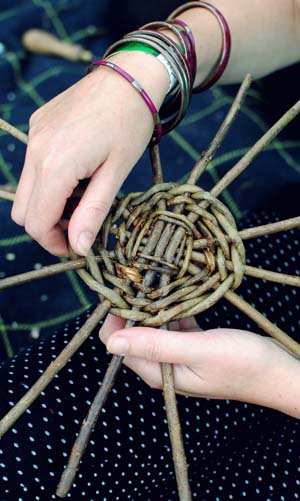
The Somerset Levels have grown willow since prehistoric times; the remains of a basket were found by the Glastonbury Lake Village. Willow trees are plentiful in marshlands as they can thrive in waterlogged soils. Their long flexible shoots have many uses, including furniture, fencing and fish traps.

Traditional methods of pruning, or pollarding, cut the tree back to its main trunk. A shock of long straight withies springs out from the cut, and can be harvested. The trees are quite tall and have a distinctive knobby shape. Pollarded trees need to be maintained, which is difficult when the trimmings have no value.

Many modern willow beds are coppiced. The growth is cut back, even to ground level, every couple of years. Material which could be used for craft products is burned as biomass fuel. Willow beds established by grant funding have no budget for upkeep.

The Levels grew nearly 40 square kilometres of willow in 1930, but this has declined to a mere 1.4, mainly due to replacing basketry with disposable bags and packaging. Garden furniture is made from imported, oil based plastic and most people would struggle to recognise a fish trap.

Planting willow around the banks of rivers stabilises them, and can be extended into a buffer zone. This would aid the retention of water in a managed flood plain, protecting urban land further downstream. Willow is particularly good at removing toxins from contaminated land. It could be planted straight after a major flood, but it won’t be, as no-one can earn a living from it.

The decline of willow production needs to be reversed by creating a market.

The storms that often accompany flooding have wreaked havoc on garden fencing. Tall solid panels which resist the wind have fallen in heaps. Woven willow fencing allows the light and air through, while affording privacy.

Order some from a local willow craftsperson. It will be more expensive than cheap imported products. If you have a garden and a fence, though, it makes sense to support the farmers upstream who are preventing them flooding. Think about what else you could replace with locally sourced willow.

Alternatively, find a project which needs help with coppicing and negotiate your own materials.  Carymoor Environment Trust in Somerset have a volunteers’ day every Tuesday.

willow crafts


Driving in the Water Margins

Here on the levels in Somerset between the sea and the high ground we’re used to seeing the water. Driving between towns, the fields are shimmering mirrors, traced with sunken hedges, populated by opportunistic swans. The main roads are edged by dark puddles, threatening to merge over the white line with every fresh downpour.

Villages hugging the tiny ridges of high ground out in the marshlands are often cut off. Farm tractors become informal delivery vans and buses. Rows of willow trees, planted so that people can see where the road was, come into their own. The river lurks just over a low bank.

The network of narrow lanes across country are under water in many places, especially at the crossroads and gateways where you could have turned around. If you come upon one flooded section, chances are there are more ahead. It’s unwise to use these lanes as a short cut.

Towns are linked by single main roads. An incident on one of these could involve you in a twenty mile diversion just to get back from the shops. If that route then becomes blocked – easy enough with the high winds and dangerous conditions – hundreds of people could become stranded for hours.

Keep at least half a tank of fuel, even for local journeys. Carry waterproofs, wellies and a drink of water in your car. Make sure your mobile phone is charged.

Shop with a list and bring in extra long life food. Try to avoid going out at all in heavy rain. Start using all those ready meals in the freezer; if your electricity goes, they will be a write off anyway.

Night time is the most dangerous. Plan to stay in, invite neighbours round, play cards or games, learn to knit. Spending all your evenings slumped in front of the TV will soon give you cabin fever!

Driving through flood water is unwise, especially if you are on your own. You can’t see how deep it is, if the road has been washed away underneath, if there are any obstructions ahead. Your electrics may get damaged.

Don’t change gears but drive slowly and steadily. If your engine cuts out, it may have got water in it. Trying to restart it might destroy it.

Even six inches of fast moving water can sweep you off your feet, and not much more can move your car. If you become trapped in a flood, call for help at once. Don’t panic and think very carefully about your escape route.

Resilience is about adaptation. Change your behaviour in response to the environment. Go out as little as possible and make every journey count. Even if you’re not directly affected by flooding, you could still be caught up in a diversion as police try to clear another area. Your presence on the road is one more factor for the emergency services to take into account, so don’t waste it.


Roast dinner and leftover stew

You’ll find that collecting vegetables from the garden adds to the preparation time for a large meal. They need to be dug up, washed and trimmed. You can economise on effort by cooking more than you need and adding the surplus to a stew the next day.

Buy a bird or joint for a roast dinner. You can afford organic free range, as you’re going to be able to get up to twelve adult meals from under £10 worth. While it is cooking, use the oven to roast trays of potatoes, onions, parsnips, carrots and squash – whatever you have available. Keep enough room for a tray of Yorkshire puddings to go in later.

Timing is crucial. Wash all the vegetables. The meat will take longest to cook, so put it in first. Read some recipes for more exact times. After the meat has cooked for awhile, the roast potatoes are next. Put them on the shelf above the meat until they start to brown when you can move them lower. If you get fed up waiting for this to happen, you might be able to finish them off under the grill. Don’t forget they are there.

Make a Yorkshire pudding mix using one egg, two tablespoons of plain flour and four fluid ounces of milk. It needs to stand for at least half an hour before cooking. Longer is better.

Prepare the vegetables for roasting. They can go in when the potatoes are getting soft nearly to the middle. You could move the meat down a shelf now. Do use hand protection when moving hot oven shelves, always take the trays off and set them on a heat proof surface first, and be careful of hot oil.

Cut up some cauliflower, shred brassica leaves, spinach or chard ready for steaming on the hob. Take your Yorkshire pudding trays, add a teaspoon of oil in the bottom of each and put the empty tray near the top of the oven for the oil to heat up.

Check the progress of the other things in the oven. The meat should be nearly ready to take out and the vegetables almost edible. If not, this is a good time to tidy up. When everything else is up to speed, take out the trays and carefully add a couple of tablespoons of the batter mix to each. The above amounts should make six, just share it around, they don’t need to be very full. Return them to the oven, near the top. Start steaming the vegetables.

The idea is to smother everyone’s plate with vegetables so that they do not notice there is only a small piece of meat each. The Yorkshires are for filler, and if you can make a thick gravy using the juices from the roasting dish, so much the better.

Hide the rest of the meat, or otherwise ensure no-one is going for seconds or midnight raids. There should be a mixture of vegetables left over. Keep these for the next day’s cooking, when you will be making leftover stew, possibly with dumplings. If you bought a bird, you can make a stock with the carcass and use this as a base for a broth on the third day.

An expanded version of this strategy, along with recipes for vegetables, has been included in ‘Recipes for Resilience’, to be published in 2018.

Mince and Barley Broth

This is incredibly cheap and can be put together in minutes, then left to cook while you do other things.

Use a large pan. Take a half pound (about 250 grams) of mince, preferably from your local butcher, and brown it in a little oil. A dash of soy sauce at this stage improves the colour. Add a couple of finely chopped onions, herbs and garlic.

Stir till the onion is soft, then lightly sprinkle with plain flour and stir some more. Slowly add a litre of hot water as you stir, then crumble a stock cube into the broth. Throw in a couple of handfuls of dried barley grains and simmer on a low heat for at least half an hour, stirring occasionally.

Serve with bread. This broth provides a nourishing meal for at least four people.  Increase the quantities to feed more.

At this time of year you will find that your stored potatoes begin to soften and sprout. Soon they will no longer be a reliable source of carbohydrates and the resilient household will need to turn to grains.

The leeks you planted last year will be ready to use now, and can be substituted for onion in this recipe. For extra vitamins, add shreds of new brassica leaves or throw in a handful of chopped wilted rocket just before serving. Use up the last of the potatoes, carrots and parsnip over the Spring to bulk the broth up into a stew.

Dedicated survivalists can, of course, strip the meat from a lightly roasted rabbit or squirrel and make a stock from the carcass instead of using mince and hot water.

What is ‘Transition’?

The Transition movement takes a positive attitude to the changes we will need to make in order to cope with the end of cheap oil.

With the price of fuel, you may not feel that oil is cheap in any real sense, but for operating machinery, running factories and processing other natural resources the power of fossil fuel was incredible compared to that of manual labour. After centuries of runaway technological growth, we are finally arriving at the point where advanced machine design and renewable energy sources can replace the use of oil, and just in time as it is becoming harder to obtain.

The infrastructure, and to some extent the lifestyle, created around fossil fuels needs to change. The Transition network is dedicated to supporting this process. Totnes, in Devon, became the first ‘Transition Town’ in 2006, and many others have followed.

A Transition Initiative looks at forming an energy descent action plan for their area, exploring how local resources can be used in a more sustainable model, and outlining the path of this transition. As life with lower energy consumption is inevitable, it is best to plan for it and Transition maintains that the increase in quality of life will more than compensate for any inconvenience.

The Transition movement has local branches all over the country. Transition is ‘an invitation to join the hundreds of communities around the world who are taking the steps towards making a nourishing and abundant future a reality’

Rob Hopkins, The Transition Handbook


Community Resilience and Emergency Welfare Newsletter

C.R.E.W are borrowing space here to post their steward newsletter until they can sort out a new website; however this coincides with some exciting changes in their organisation…

“Hi to all our loyal and fabulous volunteers!

Wishing you all a merry festive season!

We have rather suddenly got a new email address crewcic@gmail.com since the locally based Ergonet hosting company went bust – please direct all stewarding enquiries here for the moment and we will let you know if this changes. They wouldn’t let us send out this newsletter.

We’re seeking funding for a new website, which will come with a proper email address.

We’ve now become a Community Interest Company so that we can develop more of our resilience courses and practical skills camps. We’ll still be running stewards at One Love next summer, but not the Green Gathering. However, we are recruiting people for traffic management at the Langport Scythe Fair in June, and are looking for small event work especially in Somerset.

For next year, we’re planning low cost resilience training courses in France, the opportunity to meet up at an established camp and various hands-on craft events, among other things. We’ll send out a more detailed newsletter in the New Year.

As we are now a proper company we are building up a stock of useful items and local craftworks for sale to raise money for providing training in all aspects of resilience. For example….

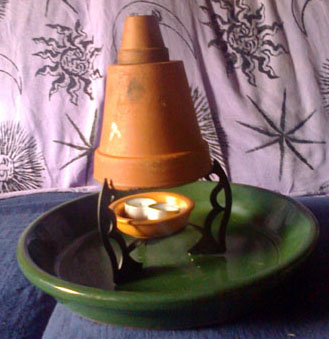
Candle stove (as seen on Facebook except this one has been researched and tested for the past year)

 new design 72ppi

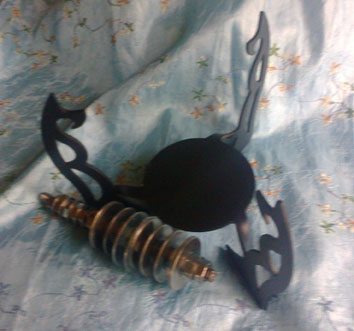
 The key features are the stainless steel core and the metal stand, which we can supply for £25 (Stand £20, core £7.50 sold separately) with full instructions.  Contact the temporary gmail address above for details

 new stand and core 72ppi

Resilience Handbook a 32 page A5 booklet with the basic outlines of the Resilience Wheel concept, as seen on our now vanished website, which is £3

Both items are post free to our volunteer community!

Our Facebook friend page CREW HQ regularly posts interesting and useful ideas around resilience and sustainability, please do join us there!

Cheers

Jane & Helene (Directors)

Linden (Secretary)

Linda (Consultant)

Simon (Marketing)”


The Hemp Twine Project – Introduction

There are just over half a million people in Somerset. Imagine if, just once a year, half of those people bought an item on which a local supplier made fifty pence profit. That would generate an amazing £125,000 for the local economy. More jobs created and investment in local initiatives…..at Community Resilience and Emergency Welfare CIC they have developed this concept into the Hemp Twine Project.

They were looking for an item, not too large or expensive, that always comes in handy and could be fully sourced locally. Although there are a few things made in Somerset, such as lavender oil, they decided to start a new product. This was an educational exercise rather than a commercial venture after all.

Everybody uses string. It’s not on the regular shopping list, but it’s not a luxury item either. It keeps very well, is easy to store and cheap to buy. Most household string is made of oil based plastic or imported cotton. Replacing this in your home with a locally sourced, organically grown, biodegradable string is definitely Good for the Environment.

As well as wool and apples, Somerset can grow large amounts of hemp. This used to be processed into fibre and supplied the local shipyards in the days of sail. Hemp as a material is remarkably resistant to rot, even in challenging salt water conditions, so it was often used in ropes and canvas. Nylon and plastic ousted natural fibres awhile ago, and the industry fell into decline. The soil and weather conditions which favoured hemp production are still in place though, and it is a crop which requires no chemical intervention to thrive.

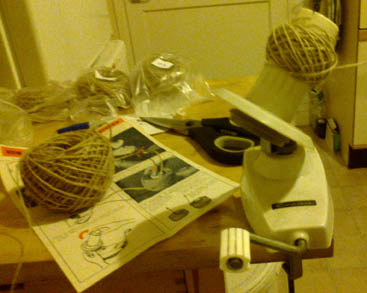
Today, hemp twine is sold to the home craft market, for use in beadwork or macrame. Sourcing a larger quantity was difficult but, with the aid of the amazing desktop ball of string maker, finally translated into a product at the right price.

old fashioned string winding machine
The old fashioned winding machine is fed from a reel on the right and makes neat balls of twine

If enough people buy hemp twine, the hemp industry could revive faster than it fell. Farmers would be paid well for a low cost crop, a small industrial unit would suffice to process the fibre into twine and local shops would profit from the sales. Spin offs include hemp oil, valuable as a source of Omega-3, hemp cake for cattle and hempcrete for building material. Each of these can underpin another entire small industry.

All that is needed is a market – your one ball of string a year – and the local economy could be richer by a whole new industry! With a steady income from conscious consumerism, businesses can plan ahead. Instead of playing the customer loyalty game with uncaring multinationals, bring it home.

Think what else you could create by buying local.