Category Archives: resilience

Growing Rocket

Rocket leaves are good in salads. Once you are used to the slightly peppery taste, you may find ordinary lettuce too bland.

It’s this taste which makes it resistant to slug attack. Rocket is easy to grow, and can be sown any time of year for a crop of fresh leaves. These contain the essential vitamin C not found in preserved foods.

If sown in autumn, the plant will overwinter as a small form, about 20cm (8 inches) high, with many leaves. These are densely packed, providing good ground cover so that little weeding is required.

You can use this as cut and come again for winter salads. Even if covered by snow, the plant can quickly regroup to produce more leaves. If it is protected from frost, you can browse on it all winter.

When spring arrives, though, it will grow quickly, with long tough stems. Flowers, as shown in the picture, appear. The energy of the plant will be directed to seeding, so the leaves will gradually become tatty from the attacks of small pests. All parts of the plant remain edible, though, and the flowers make a pretty decoration for summer salads.

The leaves become more fiddly to collect, so once the wild garlic is out and if you can use the space for more seasonal vegetables, dig up most of the rocket at this point. Leave the best looking plants to carry on flowering. They’ll produce seed, which you can harvest when the seed pods are dry. You can use this seed to sow your next crop of rocket.

It is a prolific self seeder as well, so learn to distinguish these seedlings from inedible weeds. If you allowed any rocket to go to seed this spring, the seedlings will be coming up right now. Sowing on a different patch with saved seed can be left until September.
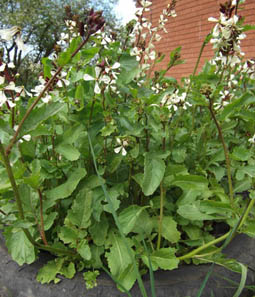
flowering rocket plants

This article was written to accompany packets of rocket seeds donated to the Fair Frome Food Bank in Somerset.  For more information about this project, please visit here
New ways of thinking

A statement with very important implications and data back up

“The irregularity of investment returns stirs up wealth differences while transactions of all types between people tend to wipe them out.”

and a confrontational rant

” Don’t pretend you’re too far out the system to vote and then get your food from a supermarket. The word for that is ‘hypocrite’ not ‘rebel’ ”

Which got more response?

Which needs to get more response?

Radiation Measuring Devices

One click on a Geiger counter signifies a single nuclear disintegration, but not the type of radiation released by it. This could be alpha, beta or gamma. The clicks per second can be easily translated into becquerel, and will give the rate at which the living tissue is receiving radioactive particles. The intensity of the radiation source is being measured here.

The biological effect of this, expressed in sieverts, depends on several other factors. A conversion between these units is not easy. Modern devices provide a ‘best guess’ of the sievert equivalent. Some may not detect alpha or beta radiation. Incorporating a mica window allows these particles to be measured, though calibration to sieverts becomes more challenging then.

Microsieverts (µSv) are the most common unit. American equipment may be calibrated in millirems (mrems). One millirem equals ten microsieverts.  Millisieverts (mSv) may also be used; one millisievert (1000 µSv) is a dangerous dose.  [100 mrem; the recommended maximum yearly exposure for the general public]  As radiation is accumulative, you should leave the area as quickly as possible.

Some Geiger counters will give data on dose per hour. The average safety limit for workers in the nuclear industry is 20 mSv/year. Firefighters at the Chernobyl nuclear power plant received an average 12 Sv over their period of exposure, from which all were ill and 30 died quickly.

Radiation on food or in water is harder to measure. Dust from a nuclear incident lands on these and contaminates them. Careful calibration against background radiation and long measuring periods, up to 12 hours, are required. Although the intensity of these sources may be low, the biological effect is compounded by ingesting them. Covering food, bringing farm animals indoors and filtering water can help.

A Geiger counter will not tell you what kind of radioactive sustance is present on food. Safety limits range from only 10 becquerels per kilogram when dealing with plutonium, to 10,000 Bq/Kg for tritium or carbon-14.

The best use of a Geiger counter in a serious emergency is to find a safe place, with a tolerable level of radioactivity. You should remain under cover until the majority of the fallout has dispersed. Four days is a recommended minimum, so a reading of 10 mSv would be the upper limit.

Remember you are keeping dust out, so you are better off in a building. Make sure there is enough water. The longer you can stay there the better, as fallout will now be covering the ground. The danger comes from inhaling or ingesting these fine particles.

Good luck with survival. You might wish you’d been less hostile to wind power.


Measuring Radiation – Sieverts and Greys

The International System of Units (SI) is the most popular system of measurement globally. Radiation units have been brought into this. Becquerels measure quantity and coulombs per kilogram are used instead of roentgens to denote exposure.

Grays (Gy) measure the absorbed dose. A gray is defined as the absorption of one joule of radiation energy by one kilogram of any matter, not just air as with the roentgen unit. One gray is equal to 100 rads. Five grays at once is a lethal dose. Diagnostic medical treatments are usually measured in milligrays (mGy).

An abdominal X-ray gives a dose of 0.7 mGy, while a computerised tomography (CT) scan is higher, at about 6 mGy. Cancer treatments exceed the lethal dose, but in small increments. Up to 80 Gy can be given, in doses of 2 Gy at a time.

Any given amount of radiation may not have the same biological effect. This is influenced by differences in the type of radiation and the conditions of exposure. Where X-rays and gamma rays are concerned, the absorbed dose is the same as the equivalent dose. If alpha particles are involved, the biological damage is more severe and weighting factors are applied. The sievert is the resultant unit.

A sievert (SV) is the standard international measurement of equivalent dose, replacing the rem. Sieverts express the potential for damage to human tissue, and are related to grays. One sievert is equivalent to one hundred rems, which would be a lethal dose. A microsievert (µSv) is one millionth of a sievert. One tenth of a microsievert is the natural radiation found in an average banana.

part four ‘Measuring Devices’ to follow

Measuring Radiation – Roentgens, Rads and Rems

The roentgen is defined as 2.58 x 10⁻⁴ coulombs of charge produced by X-rays or gamma rays per kilogram of air.

A roentgen is a lot of radiation. A dose of 500 roentgens within five hours will kill you. So a place with a reading of 100 roentgens per hour or more is very dangerous. Shortly after the Chernobyl nuclear disaster, readings of up to 30,000 R/hr were recorded in some areas.

Devices are usually calibrated in tiny fractions of one roentgen. There are a thousand milliroentgens to one roentgen. The reading will often be given in mR/hr. Flying at high altitudes exposes passengers to around 25 mR/hr, due to cosmic radiation.

Rad stands for Radiation Absorbed Dose. The units used here relate to the amount of radiation absorbed by the irradiated material. This may be you. One rad indicates exposure equivalent to an energy of 100 ergs per gram. It is about the same as 1.07 Roentgen, or 1,070 mR.

Rads are useful when assessing whether acute radiation sickness is a risk. A dose of 10 rads (10,000 mrads) in less than an hour is dangerous. Treatment for ARS will be needed.

The absorbed dose, measured in rads, is adjusted to give the Roentgen Equivalent in Man. The type of radioactive material is taken into account, among other factors. This unit is used to assess the chances of getting cancer from exposure. It is used to calculate safe levels in industry and medicine.

A rem is a large amount, so readings are generally given in millirem (mrem). The general public should not be exposed to over 100 mrem per year. This is just over the natural radiation levels inside a building made of granite.

Roentgens, rads and rems are very roughly equivalent. As the adoption of international standards became important, they were replaced by other units. Some countries, particularly the USA, continue to use the old ones.

part three ‘Sieverts and Grays’ to follow

Measuring Radiation – Curies and Becquerel

Devices are available to measure radiation, from expensive Geiger Counters to smartphone apps. There are several different units used. Some areas or items have naturally high radiation levels which confuse readings. It’s difficult for an amateur to work out how dangerous a source might be.

Curies and Becquerel

A curie (C) is the original unit used to describe the intensity of radioactivity. It is based on the physical properties of radioactive material, as the dangers of exposure were not well understood at the time. One curie is the radioactivity of a single gram of radium.

A microcurie is a millionth of a curie and a picocurie is a trillionth. Thirty seven billion becquerel (Bq) equal one curie. A becquerel is thus about 27 picocuries (pCi). Modern convention has replaced the curie as a unit with becquerels. As these are tiny, measurements are often given in kilobecquerels (1000 Bq) or megabecquerels (1,000,000 Bq).

The unit is named after the French scientist who discovered radioactivity, Antoine-Henri Becquerel.  It describes one atomic disintegration per second. These disintegrations release energetic particles, which are the basis of radioactivity. The process is called decay.

Alpha particles are the largest, the same size as a helium atom. Beta particles are smaller, but can be stopped by a shield only a few millimeters thick. Gamma rays, a sort of proton, can penetrate up to two feet of concrete.

Skin and clothes protect against the larger particles. If radioactive atoms enter the body, however, these particles will hit cells directly during decay. A nuclear incident distributes these atoms in the air, water and food.

Radioactive material presents two types of hazard. There is the danger of being too close to an emitting source, and the risk of ingesting small fragments of it. This risk increases dramatically if the source explodes. Nuclear fallout is the resultant dust.

Although the luminous properties of radium and other elements were exploited for various gadgets, the dangers of emitting sources are now recognised. The public are unlikely to come into contact with them, except during medical treatments.

X-rays and radiotherapy both use radiation. A means of measuring the risks to patients and staff was needed. New systems were explored, designed to express the biohazard aspect, the actual damage done to living tissues.

Part Two ‘Roentgens, Rads and Rems’ to follow

© E J Walker 2014


Not too late to grow food!

The rain has finally eased off in Somerset and the sun even comes out occasionally. The soil is saturated and the legions of molluscs are emerging from their winter caves. Yet the intrepid gardener must make the best of it and see what can be grown.

Adding some dry compost or soil improver before sowing will help to soak up the water in seed beds. Circling these with a ring of dry bran discourage slugs. Try and avoid resorting to chemical pellets, though the neighbourhood cats have probably put paid to any natural predators.

If you have windowsill or greenhouse space, start some plants off there. Don’t put them all out at once. Grow enough to have a reserve, and be careful to harden them off before planting out. Healthy plants are the best defence against pests.

It won’t be a good year for the more delicate vegetables. Potatoes can hold their own in most circumstances. Plant them around the edges. The hairy leaves of pumpkins and squash are also resistant to attack, though it is too early for these to go outside. Sow a catch crop of radish or cress in the large patch of empty space they will need later.

Remember to feed your soil. The liquid fertiliser you made last year from comfrey and nettle leaves will do just fine. Peas and beans make their own nitrogen, however, so don’t overdo it around them. Avoid treading on the soil to keep its structure intact. Keep to marked paths in large beds. Once the soil is properly aerated, the difference is obvious.

Brassicas will need constant attention this year. They’re worth some trouble for their winter leaves and the delicious sprouting heads in the following Spring. However, if they can survive the mollusc army, the caterpillars will be next. Planting nasturtiums in the same bed distracts these creatures, who will munch on them by preference.

Leeks do better in clay soil than onions. They develop slowly but steadily, requiring little maintenance apart from weeding. Root vegetables prefer sandier soil, which you can mix yourself to cultivate carrots in pots, or the larger parsnips in tyres.

Finally, don’t forget to sow some borage and marigold. The colourful flowers attract bees and make the vegetable patch look decorative. Happy gardening!

© Elizabeth J Walker 2014


A community transport hub

Imagine not a simple bus shelter, but a small building in every village, at every key location in towns and cities. It’s furnished with cushioned chairs, magazines and a water dispenser. The place is kept clean and maintained by a rota of local people. The solar panels on the roof provide power for lighting – including the ‘Stop’ light outside so that the bus driver knows there are passengers to pick up.

Buses come every hour at most and there is thoughtful scheduling of connections. No matter how long or awkward your journey, you never have to wait more than an hour to catch your next link. Fares are cheap. A day pass costs scarcely more than a single journey. A conductor helps you on with your luggage, and can advise you about other services.

There are lockers in the building, operated by tokens or small coins, where you can leave your shopping and go for lunch. Or lock your bicycle to the racks outside and store your wet weather gear to catch the bus for the trip to work in town.

Shoppers are transported directly into the town centres. The independent shops do well, local produce sells and is encouraged, money stays within the community. Many new jobs are created.

There is a community notice board at the hub, with news of events, official meetings, items for sale or wanted. At busy times, a local business brings a small mobile stand for newspapers and refreshments. There is a roll-out awning on one side of the building to protect a weekly produce stand, or a sale in aid of some project.

The buses are partly run on electricity, and there is a charging point close to the hub, perhaps powered by the community windmill. The surplus is available to local disabled people to charge their small electric cars.

A network of bicycle tracks links these hubs. They often use different, traffic free routes with the occasional shelter along them in case of heavy rain. Footpaths sometimes follow these routes, sometimes diverge into wilder, more scenic areas.

Where does the land come from for these hub buildings?

Car parks.

© Elizabeth J Walker 2014

What do you need from transport?

You need to get yourself, possibly your family of young children, an elderly relative, maybe a dog, from here to there. You don’t want it to be prohibitively expensive, you don’t want to have to wait around in the rain or lug heavy bags a long way.

A car was the answer! Everybody got one, and then two, even three!

Then you begin to fall out with your neighbours over parking. The cost of running a car goes up by the day. You are getting unfit because you drive everywhere, so you consider a bicycle. The roads are too dangerous because they are full of cars. You think about the bus, but they are costly, infrequent and often unreliable or non-existent in rural areas.

Depending on your car means depending on oil, mainly from other countries. The news is full of the trouble and deadly conflict caused by arguments over who controls these fuel resources. You hear of the vast areas of pollution surrounding extraction sites.

Always the price you pay for fuel rises, and a disruption of supplies brings your entire lifestyle to a stop – this is not resilient!

We are addicted to the use of oil. It will not be easy to cut back, but it must be done. Local initiatives are the key to encouraging government and business to get involved. They will not do so without public pressure, both political and by the use of your spending power.

Change is happening slowly, but it needs more people to engage with the process. Here’s a couple of good places to start.

The Urban Walking route planner gives you a route map between any two points, including your journey time, calorie burn, step count and carbon saving. It’s quick, free, healthy and green!

Sustrans is a charity enabling people to travel by foot, bike or public transport for more of the journeys we make every day. They work with families, communities, policy-makers and partner organisations so that people are able to choose healthier, cleaner and cheaper journeys, with better places and spaces to move through and live in.


© Elizabeth J Walker 2014

Willows and Flooding

The Somerset Levels have grown willow since prehistoric times; the remains of a basket were found by the Glastonbury Lake Village. Willow trees are plentiful in marshlands as they can thrive in waterlogged soils. Their long flexible shoots have many uses, including furniture, fencing and fish traps.

Traditional methods of pruning, or pollarding, cut the tree back to its main trunk. A shock of long straight withies springs out from the cut, and can be harvested. The trees are quite tall and have a distinctive knobby shape. Pollarded trees need to be maintained, which is difficult when the trimmings have no value.

Many modern willow beds are coppiced. The growth is cut back, even to ground level, every couple of years. Material which could be used for craft products is burned as biomass fuel. Willow beds established by grant funding have no budget for upkeep.

The Levels grew nearly 40 square kilometres of willow in 1930, but this has declined to a mere 1.4, mainly due to replacing basketry with disposable bags and packaging. Garden furniture is made from imported, oil based plastic and most people would struggle to recognise a fish trap.

Planting willow around the banks of rivers stabilises them, and can be extended into a buffer zone. This would aid the retention of water in a managed flood plain, protecting urban land further downstream. Willow is particularly good at removing toxins from contaminated land. It could be planted straight after a major flood, but it won’t be, as no-one can earn a living from it.

The decline of willow production needs to be reversed by creating a market.

The storms that often accompany flooding have wreaked havoc on garden fencing. Tall solid panels which resist the wind have fallen in heaps. Woven willow fencing allows the light and air through, while affording privacy.

Order some from a local willow craftsperson. It will be more expensive than cheap imported products. If you have a garden and a fence, though, it makes sense to support the farmers upstream who are preventing them flooding. Think about what else you could replace with locally sourced willow.

Alternatively, find a project which needs help with coppicing and negotiate your own materials.  Carymoor Environment Trust in Somerset have a volunteers’ day every Tuesday.

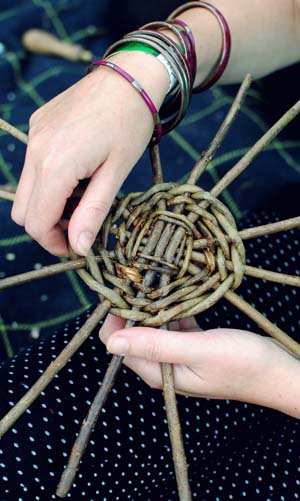
willow crafts