London Transport

After my experience on the Road to Hell, I reconsidered my plan to drive to London that weekend. Clearly, more vehicles was not what the situation there needed.

I booked a ticket over the phone with Berry’s Coaches, a local firm. I boarded at Glastonbury Town Hall, read Private Eye and a newspaper, and was in Hammersmith before I had got round to the puzzles.

The new Underground trains were a little disconcerting. There aren’t any divisions between the carriages. You can see down the whole length of the train, how it twists and leans on the track ahead. With an Oyster card, a stranger in town has to take the fares on trust, but I’m always pleasantly surprised by its remaining balance. The entire return trip from Somerset cost me under £30.

Cheaper than the diesel for my somewhat rural camper van. No worries about overheating in traffic jams, finding somewhere to park or straying into the Low Emission Zone! I have to admit that the air quality in central London is greatly improved due to this policy, which excludes elderly diesel vans, even if it puts me to some inconvenience.

News is easy to come by here. If you’re not hooked into the direct feed of your smartphone, there are free newspapers everywhere.

I read about the London living wage campaign, to which many firms have already signed up. If workers could afford to live within walking distance of their jobs, this would reduce the commuter traffic.

Labour threatened to change the name of the House of Lords to the ‘Senate’ and move it to Manchester. This too would make a major contribution to reducing congestion. The frantic dashing of lobbyists between Houses would be offset by the regular travelling of the support staff.

Finally, such a valid reason for the HS2 that one wonders which idea has precedence here. If there’s a joined up plan, why not share it with us stakeholders who will have to pay for it?

Life in the Slow Lane

I don’t often drive to London or the South-east, but I had to travel to Hastings recently.

We came in on the M3 onto the M25 and down the A21. There were traffic jams on all these roads, sometimes over twenty minutes long. Once in Hastings, we navigated around the city at a crawl. On the way home, we paid close attention to the traffic news.

A crane broke down in the anti-clockwise carriageway just north of the M3. Traffic was at a standstill in all three lanes, and eventually the gridlock seemed to stretch all the way up to the M1. Luckily, we were on the other side, and it only took us four hours to win clear of the congestion.

While on the M25, all we could see in front of us was row upon row of tail lights, four cars wide, stretching to the horizon. From the side, more vehicles edged into this choking stream. Lanes full of cars trying to leave lined the slip roads. Lorries, run out of legal driving time, were beginning to park on the hard shoulders.

The air was thick with fumes as gallons of precious oil burned away in this insane exercise. Has no-one told you people that this is crazy?

It wasn’t freight traffic causing the problem, but thousands upon thousands of people in cars. As it was early evening, one would have to assume that they were coming home from work.

Developers are allowed to create residential deserts, devoid of any meaningful employment. Companies working within London – and other cities – take no responsibility for bringing in thousands of workers daily.

The whole situation is driven by greed and need. There is a lack of joined up responsibility here which urgently needs to be addressed.

Diary, September 2014

Here at the house with the resilience garden, I’m in the last stages of getting the Resilience Handbook ready to publish – just the Interludes and Conclusion to do, then choosing some illustrations.

How do I persuade you how easy it is to jump on the Resilience bandwagon?

Off we go, waving hand made banners and singing, to the future that can exist! If we get a flat tyre, we’ll all pile out while it gets fixed. Some people will build shelters for the night, others cook up a meal for everyone, then away we go again in the morning! We know where we’re going and how to get there, even though it will take a while.

Sustainability with meaning. A defined goal with measurable steps.

And a Resilience Plan is fun, of course. It’s part of the core plan.

Between the hours of typing on to a screen and counting words, I’m making wine. It’s that time of year. The elderberries – which make a deep rich red – are gone now, but I may catch some blackberries. Sloes are easy to collect but the wine needs to mature for several years; then there are rosehips and apples to see me through till December.

If the weather stays nice, there’s an expedition to Carymoor eco centre on the cards. They aren’t using their blackberries, and they have willow beds. I need to make some willow fencing to go across the front of the garden. Having failed to explain to the neighbours why this would be a better replacement for their storm-downed solid panels than more of the same, perhaps I can show them instead.

And occasionally I get to have an evening in on my own listening to DVDs and working on my Turkish style rug. It’s nearly six inches long now!

Knotted rug on frame loom with resilience garden behind

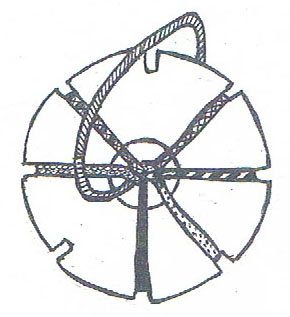
How to use a Spider to braid cord

for the people I met on my travels this summer

Find some thick card which does not crease easily, yet isn’t too thick to cut. A scrap of mounting board is ideal. Draw a circle about 9 cm across and cut it out. Divide the circumference into 8 sections of roughly equal size. Cut a thin notch, no more than 1 cm long, along each dividing line. Around the centre of your circle, cut out a hole about 1 cm across.

This is a spider.

Cut seven equal lengths of wool, ribbon or thread and knot them together at one end. Push the knotted end through the hole in the spider and lay the threads on top.

preparing the spider for braiding cord

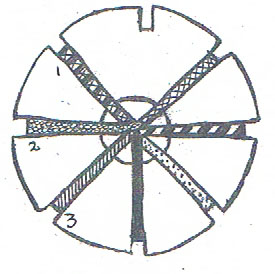
Slot each thread into one of the notches around the edge. The notch should grip the thread quite tightly. There will be an empty notch. Hold the spider so that this is at the top.

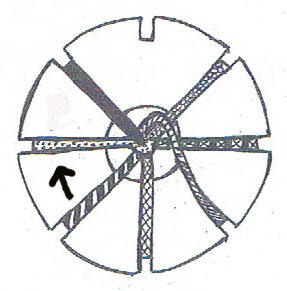
Count three threads to the left. Take the third thread and lift it over the first two, slotting it  into the empty notch.

taking the third thread from the left across the other two and into the empty notch

Turn the spider clockwise so that the new empty notch is now at the top. Repeat the process, lifting the third thread to the left over the other two. Your cord will start to form in the centre.

spider 3 v2

Keep the braiding firm but not overtight.

As you work, the loose ends waiting to be braided get tangled. Separate them every so often. This limits the length of your starter thread to about two arms’ length, but once you get the hang of braiding, you can splice new lengths in. Do these one at a time to avoid unsightly lumps, and to maintain the cord strength.

Once you have had some practise and know what you need this tool to do, you could cut a longer lasting version from thin plywood. Try making cord from wild grasses, braid heavy duty cables from thin rope using a much larger spider.

The use of braided wicks was a key development in candle technology. Can you replicate this process? Could you invent a simple machine to braid cord? Why might you need to?

Growing Rocket

Rocket leaves are good in salads. Once you are used to the slightly peppery taste, you may find ordinary lettuce too bland.

It’s this taste which makes it resistant to slug attack. Rocket is easy to grow, and can be sown any time of year for a crop of fresh leaves. These contain the essential vitamin C not found in preserved foods.

If sown in autumn, the plant will overwinter as a small form, about 20cm (8 inches) high, with many leaves. These are densely packed, providing good ground cover so that little weeding is required.

You can use this as cut and come again for winter salads. Even if covered by snow, the plant can quickly regroup to produce more leaves. If it is protected from frost, you can browse on it all winter.

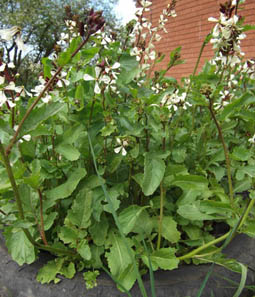
When spring arrives, though, it will grow quickly, with long tough stems. Flowers, as shown in the picture, appear. The energy of the plant will be directed to seeding, so the leaves will gradually become tatty from the attacks of small pests. All parts of the plant remain edible, though, and the flowers make a pretty decoration for summer salads.

The leaves become more fiddly to collect, so once the wild garlic is out and if you can use the space for more seasonal vegetables, dig up most of the rocket at this point. Leave the best looking plants to carry on flowering. They’ll produce seed, which you can harvest when the seed pods are dry. You can use this seed to sow your next crop of rocket.

It is a prolific self seeder as well, so learn to distinguish these seedlings from inedible weeds. If you allowed any rocket to go to seed this spring, the seedlings will be coming up right now. Sowing on a different patch with saved seed can be left until September.

flowering rocket plants

This article was written to accompany packets of rocket seeds donated to the Fair Frome Food Bank in Somerset.  For more information about this project, please visit here

New ways of thinking

A statement with very important implications and data back up

“The irregularity of investment returns stirs up wealth differences while transactions of all types between people tend to wipe them out.”

and a confrontational rant

” Don’t pretend you’re too far out the system to vote and then get your food from a supermarket. The word for that is ‘hypocrite’ not ‘rebel’ ”

Which got more response?

Which needs to get more response?

Radiation Measuring Devices

One click on a Geiger counter signifies a single nuclear disintegration, but not the type of radiation released by it. This could be alpha, beta or gamma. The clicks per second can be easily translated into becquerel, and will give the rate at which the living tissue is receiving radioactive particles. The intensity of the radiation source is being measured here.

The biological effect of this, expressed in sieverts, depends on several other factors. A conversion between these units is not easy. Modern devices provide a ‘best guess’ of the sievert equivalent. Some may not detect alpha or beta radiation. Incorporating a mica window allows these particles to be measured, though calibration to sieverts becomes more challenging then.

Microsieverts (µSv) are the most common unit. American equipment may be calibrated in millirems (mrems). One millirem equals ten microsieverts.  Millisieverts (mSv) may also be used; one millisievert (1000 µSv) is a dangerous dose.  [100 mrem; the recommended maximum yearly exposure for the general public]  As radiation is accumulative, you should leave the area as quickly as possible.

Some Geiger counters will give data on dose per hour. The average safety limit for workers in the nuclear industry is 20 mSv/year. Firefighters at the Chernobyl nuclear power plant received an average 12 Sv over their period of exposure, from which all were ill and 30 died quickly.

Radiation on food or in water is harder to measure. Dust from a nuclear incident lands on these and contaminates them. Careful calibration against background radiation and long measuring periods, up to 12 hours, are required. Although the intensity of these sources may be low, the biological effect is compounded by ingesting them. Covering food, bringing farm animals indoors and filtering water can help.

A Geiger counter will not tell you what kind of radioactive sustance is present on food. Safety limits range from only 10 becquerels per kilogram when dealing with plutonium, to 10,000 Bq/Kg for tritium or carbon-14.

The best use of a Geiger counter in a serious emergency is to find a safe place, with a tolerable level of radioactivity. You should remain under cover until the majority of the fallout has dispersed. Four days is a recommended minimum, so a reading of 10 mSv would be the upper limit.

Remember you are keeping dust out, so you are better off in a building. Make sure there is enough water. The longer you can stay there the better, as fallout will now be covering the ground. The danger comes from inhaling or ingesting these fine particles.

Good luck with survival. You might wish you’d been less hostile to wind power.


Measuring Radiation – Sieverts and Greys

The International System of Units (SI) is the most popular system of measurement globally. Radiation units have been brought into this. Becquerels measure quantity and coulombs per kilogram are used instead of roentgens to denote exposure.

Grays (Gy) measure the absorbed dose. A gray is defined as the absorption of one joule of radiation energy by one kilogram of any matter, not just air as with the roentgen unit. One gray is equal to 100 rads. Five grays at once is a lethal dose. Diagnostic medical treatments are usually measured in milligrays (mGy).

An abdominal X-ray gives a dose of 0.7 mGy, while a computerised tomography (CT) scan is higher, at about 6 mGy. Cancer treatments exceed the lethal dose, but in small increments. Up to 80 Gy can be given, in doses of 2 Gy at a time.

Any given amount of radiation may not have the same biological effect. This is influenced by differences in the type of radiation and the conditions of exposure. Where X-rays and gamma rays are concerned, the absorbed dose is the same as the equivalent dose. If alpha particles are involved, the biological damage is more severe and weighting factors are applied. The sievert is the resultant unit.

A sievert (SV) is the standard international measurement of equivalent dose, replacing the rem. Sieverts express the potential for damage to human tissue, and are related to grays. One sievert is equivalent to one hundred rems, which would be a lethal dose. A microsievert (µSv) is one millionth of a sievert. One tenth of a microsievert is the natural radiation found in an average banana.

part four ‘Measuring Devices’ to follow

Measuring Radiation – Roentgens, Rads and Rems

The roentgen is defined as 2.58 x 10⁻⁴ coulombs of charge produced by X-rays or gamma rays per kilogram of air.

A roentgen is a lot of radiation. A dose of 500 roentgens within five hours will kill you. So a place with a reading of 100 roentgens per hour or more is very dangerous. Shortly after the Chernobyl nuclear disaster, readings of up to 30,000 R/hr were recorded in some areas.

Devices are usually calibrated in tiny fractions of one roentgen. There are a thousand milliroentgens to one roentgen. The reading will often be given in mR/hr. Flying at high altitudes exposes passengers to around 25 mR/hr, due to cosmic radiation.

Rad stands for Radiation Absorbed Dose. The units used here relate to the amount of radiation absorbed by the irradiated material. This may be you. One rad indicates exposure equivalent to an energy of 100 ergs per gram. It is about the same as 1.07 Roentgen, or 1,070 mR.

Rads are useful when assessing whether acute radiation sickness is a risk. A dose of 10 rads (10,000 mrads) in less than an hour is dangerous. Treatment for ARS will be needed.

The absorbed dose, measured in rads, is adjusted to give the Roentgen Equivalent in Man. The type of radioactive material is taken into account, among other factors. This unit is used to assess the chances of getting cancer from exposure. It is used to calculate safe levels in industry and medicine.

A rem is a large amount, so readings are generally given in millirem (mrem). The general public should not be exposed to over 100 mrem per year. This is just over the natural radiation levels inside a building made of granite.

Roentgens, rads and rems are very roughly equivalent. As the adoption of international standards became important, they were replaced by other units. Some countries, particularly the USA, continue to use the old ones.

part three ‘Sieverts and Grays’ to follow

Measuring Radiation – Curies and Becquerel

Devices are available to measure radiation, from expensive Geiger Counters to smartphone apps. There are several different units used. Some areas or items have naturally high radiation levels which confuse readings. It’s difficult for an amateur to work out how dangerous a source might be.

Curies and Becquerel

A curie (C) is the original unit used to describe the intensity of radioactivity. It is based on the physical properties of radioactive material, as the dangers of exposure were not well understood at the time. One curie is the radioactivity of a single gram of radium.

A microcurie is a millionth of a curie and a picocurie is a trillionth. Thirty seven billion becquerel (Bq) equal one curie. A becquerel is thus about 27 picocuries (pCi). Modern convention has replaced the curie as a unit with becquerels. As these are tiny, measurements are often given in kilobecquerels (1000 Bq) or megabecquerels (1,000,000 Bq).

The unit is named after the French scientist who discovered radioactivity, Antoine-Henri Becquerel.  It describes one atomic disintegration per second. These disintegrations release energetic particles, which are the basis of radioactivity. The process is called decay.

Alpha particles are the largest, the same size as a helium atom. Beta particles are smaller, but can be stopped by a shield only a few millimeters thick. Gamma rays, a sort of proton, can penetrate up to two feet of concrete.

Skin and clothes protect against the larger particles. If radioactive atoms enter the body, however, these particles will hit cells directly during decay. A nuclear incident distributes these atoms in the air, water and food.

Radioactive material presents two types of hazard. There is the danger of being too close to an emitting source, and the risk of ingesting small fragments of it. This risk increases dramatically if the source explodes. Nuclear fallout is the resultant dust.

Although the luminous properties of radium and other elements were exploited for various gadgets, the dangers of emitting sources are now recognised. The public are unlikely to come into contact with them, except during medical treatments.

X-rays and radiotherapy both use radiation. A means of measuring the risks to patients and staff was needed. New systems were explored, designed to express the biohazard aspect, the actual damage done to living tissues.

Part Two ‘Roentgens, Rads and Rems’ to follow

© E J Walker 2014