Tag Archives: local food

Why was ‘Brexit’ such a surprise?

Could it be possible that a significant number of voters lied to opinion polls all along? If you admitted to voting Leave, you could expect your friends to turn on you and call you a stupid racist – an expectation justified by present events. Why risk it when the result might go their way in any case? It’s a secret ballot. Lying to pollsters was a win-win situation.

The finance markets, going with these potentially distorted polls, speculated on a Remain result, only to have the rug pulled out from underneath them during the night. For an entertaining analysis of this, watch the Max Keiser show, episode 932. Complacent in the projected result, no-one made a plan to cover the details of leaving.

No-one? Of course there are plans. The Treasury has a plan, the civil service have plans, the EU has a plan. Things that work will continue, until the politicians regroup and interfere.

Which politicians? The opposition parties are in total disarray. Refusal to abandon an open borders policy has cost them the rest of their agenda. Green Party rallying posts on Facebook are deluged with comments from their supporters denouncing their refusal to accept that Britain is overcrowded. It’s a serious situation. Exceeding the carrying capacity of your environment always ends badly for the species concerned. If anyone should be leading on this difficult issue it should be the Greens.

Instead they are talking about an alliance with the Liberal Democrats. Really? I remember the wave of adulation which swept this party into government. In the enthusiasm, one small voice stood out for me. An elder statesman wondered if they had the experience to lead, being so long in opposition.

Turns out they didn’t. Aware of the Lib Dem’s huge youth following, the Conservatives’ opening shot was raising university tuition fees. Expecting Nick Clegg to respond ‘not on your nelly, what else have you got?’ they must have fallen over backwards with surprise when he caved in.

A similar thing has just happened with the Scottish National Party. Instead of dashing off to Europe on the outrage bus, they could have murmured ‘regrettable’ and ‘considering our options’ while having secured a deal for an independent Scotland behind the scenes some time ago.  After all, the vote may represent a fear of change rather than a desire for EU membership.

Labour turns on their popular leader and shreds him, expecting this to…do what? Complete the disarray of the opposition and leave the Conservatives to set the agenda? Lose any remaining trust from their voters?

There’s change coming. It was already on its way. Look on this referendum as a defining moment if you like, but it was part of a process sweeping across the globe. A country alone can try out strategies too risky for a complex federation to embrace. You’re going to have to pay attention.

I have a plan. It’s not a quick fix but it’ll work. Get the Resilience Handbook and find out. Meanwhile, buy British. Your continuing prosperity depends on it.
June Diary 2016

I expected June to be a quieter month than it usually is for me, as I’m not going to the Glastonbury Festival for the first time in many years. There’s no going against the rhythm of the seasons though, and events conspired to make this month every bit as hectic as before!

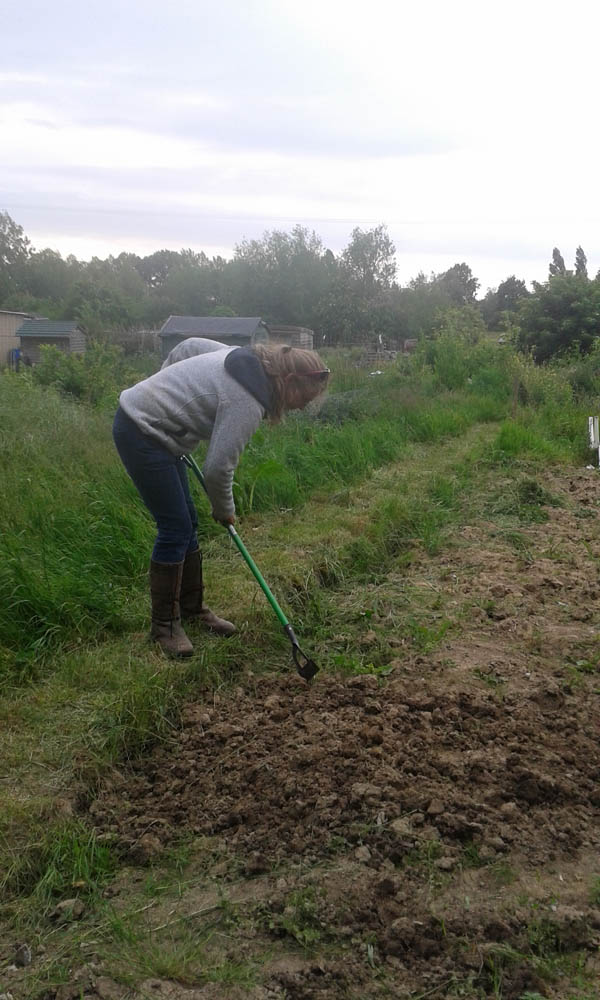
I’ve been working hard on my next book, about food and resilience…this involves a lot of experimental cooking and field studies. We finally got an allotment garden for our project; it’s quite overgrown. Although late in the season, we’ve managed to plant out the last of our seedlings, and there are quite a few food plants there already which only need the undergrowth cleared away.

Linda hoeing our new growing space

It was the Green Scythe Fair on 12th June, which is an annual fixture for me. Strolling among the colourful stalls is like visting a future where everything has worked out fine. People gather around to admire the latest electric car on display, discuss the merits of the various tools offered for sale, consider hand made clothes or choose a pair of angora rabbits to breed for wool. The faint tap of peening scythes underscores the murmer of conversation. A woman plays her fiddle while children dance; other youngsters make nests from the cut grass.

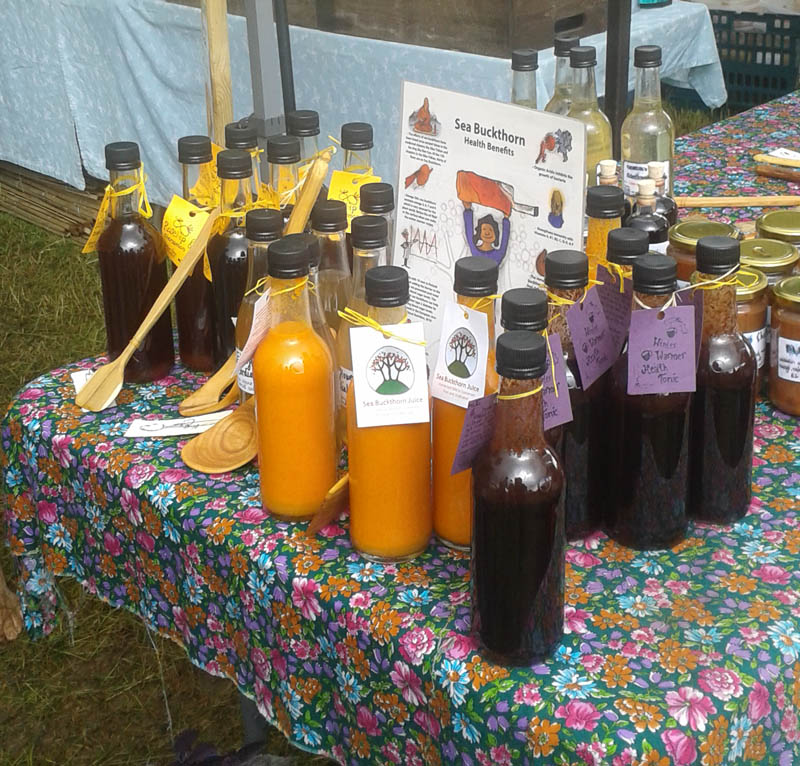
A tremendous selection of local delicacies are to be sampled here, from crystallised flowers to venison steaks.

sea buckthorn juice stall
A stall selling juice made from sea buckthorn

You can get anything you can think of to do with honey, including a hive of bees. All the brand names, the shiny labels, are absent though. The cafe heats its water by wood-fired rocket stoves; the electrical power is from storage batteries recharged by renewables, including the lights and entertainment at night.

In the Craft area, one can see blacksmiths, stone masons and thatchers at work. There’s a stall selling hemp twine, another with leather pouches. A man haggles for an enamel basin, a woman picks a new copper kettle. The plough horses watch curiously as you pass by; yesterday they were demonstrating techniques for a land workers’ training session.

The centre piece of the event is the scything. A grand marquee is set up like a scything supermarket, with blades, whetstones, files, all the odds and ends of the craft. You are ‘fitted’ for the right size of handle, consulted about the appropriate blade and shown how to attach it. The complete novice is given a introductory pamphlet, but it’s wise to enrol on one of the day courses. Like any skill, it’s best learned alongside a master.

On the day of the Fair, however, all these craftspeople were out on the long grass in the centre, where the competitions were taking place. There were trophies to be won, reputations to be made! A sudden downpour had flattened much of the grass – how would this affect the form? The skilled scythers – men and women in separate heats – would cut their allotted square down to the length of a well trimmed lawn in only a few minutes. Assistants raked up the fallen grass while the judges inspected the quality of the job and considered points.

After the business of the day was done and the cups awarded, the music and carousing began in earnest. The stalls closed up and stole away; the families left. Only the crafters and campers were left to wind the evening up in traditional style and wobble gently home across the dark, empty fields.

Shop Local for Xmas

It’s beginning to seep into national awareness that independent, locally based businesses might serve their communities better than identikit chain stores with obscure agendas.

With the destructive competition these small enterprises face from multinationals, the few that still populate the High Street need your support. It’s estimated that around £40 billion will be spent on Xmas in the UK this year; over £750 per household.

Spent locally, remaining in your area instead of instantly vanishing into a remote Head Office, this money could bring about a serious increase in prosperity.

Take a long tea break to think about this, and plan your holiday spending. Shopping in the scattered local outlets will take longer than a trolley dash. Spread it over a few weeks. Be organised so you don’t buy something twice in the last minute rush.

Set a budget for presents. See what you can find at craft fairs. Socks, especially good hand made ones, are underrated. Bath products are often welcome.  Of course you’ll be able to buy more industrially produced items for the same money. Quality is the point here. It’s a gift; it’s the thought that counts not the weight.

Traditional crafts are struggling to stay alive, despite their key role in a resilient society. The few people who persevere have to price their goods at the luxury end of the market to compete with factories. They need your custom more than the supermarkets do, and give far more back. Choose your loyalties.

Half of the total Xmas spend is on gifts. In Somerset alone, this comes to over £80 million, the same as a quarter of the annual County budget.  Another third is spent on food and drink.

Write a shopping list. There’s plenty of food you could buy well in advance. Farm shops often sell chutneys, jams and pickles. Xmas cakes keep for weeks and are often on sale at markets. Consider making your own mince pies.

The best way to buy your Xmas dinner is to order fresh locally reared organic meat from the independent butcher. If you’ve never done this before, consider there may be a bit of a queue on collection day. Bring an umbrella, a newspaper, be prepared to chat to people, live a little slower.

Spend your Xmas surrounded by food, drink and gifts which that have meaning, not just labels. Start planning now!

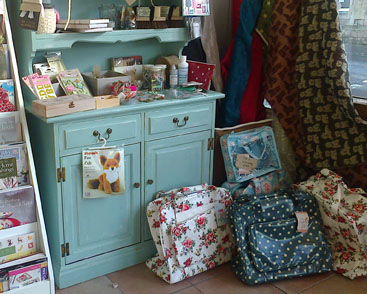
local craft shop
Buy craft materials for friends at shops like Glastonbury’s Over the Moon
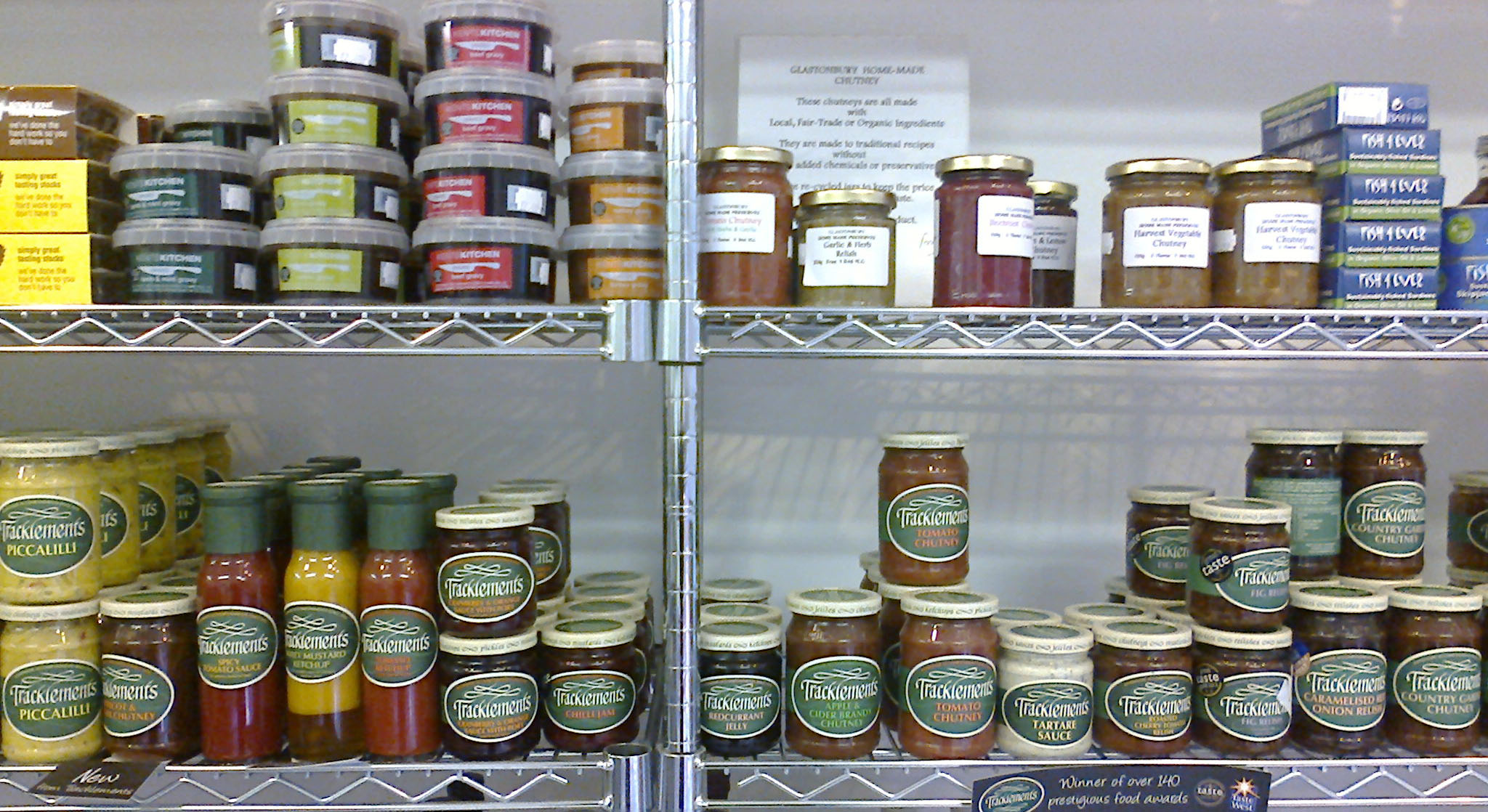
Stevens butchers on Glastonbury High Street
and while you’re in the High Street, check out the more exotic preserves at Steven’s Butchers


Growing Rocket

Rocket leaves are good in salads. Once you are used to the slightly peppery taste, you may find ordinary lettuce too bland.

It’s this taste which makes it resistant to slug attack. Rocket is easy to grow, and can be sown any time of year for a crop of fresh leaves. These contain the essential vitamin C not found in preserved foods.

If sown in autumn, the plant will overwinter as a small form, about 20cm (8 inches) high, with many leaves. These are densely packed, providing good ground cover so that little weeding is required.

You can use this as cut and come again for winter salads. Even if covered by snow, the plant can quickly regroup to produce more leaves. If it is protected from frost, you can browse on it all winter.

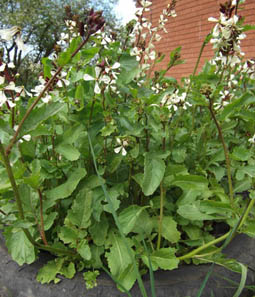
When spring arrives, though, it will grow quickly, with long tough stems. Flowers, as shown in the picture, appear. The energy of the plant will be directed to seeding, so the leaves will gradually become tatty from the attacks of small pests. All parts of the plant remain edible, though, and the flowers make a pretty decoration for summer salads.

The leaves become more fiddly to collect, so once the wild garlic is out and if you can use the space for more seasonal vegetables, dig up most of the rocket at this point. Leave the best looking plants to carry on flowering. They’ll produce seed, which you can harvest when the seed pods are dry. You can use this seed to sow your next crop of rocket.

It is a prolific self seeder as well, so learn to distinguish these seedlings from inedible weeds. If you allowed any rocket to go to seed this spring, the seedlings will be coming up right now. Sowing on a different patch with saved seed can be left until September.

flowering rocket plants

This article was written to accompany packets of rocket seeds donated to the Fair Frome Food Bank in Somerset.  For more information about this project, please visit here

Roast dinner and leftover stew

You’ll find that collecting vegetables from the garden adds to the preparation time for a large meal. They need to be dug up, washed and trimmed. You can economise on effort by cooking more than you need and adding the surplus to a stew the next day.

Buy a bird or joint for a roast dinner. You can afford organic free range, as you’re going to be able to get up to twelve adult meals from under £10 worth. While it is cooking, use the oven to roast trays of potatoes, onions, parsnips, carrots and squash – whatever you have available. Keep enough room for a tray of Yorkshire puddings to go in later.

Timing is crucial. Wash all the vegetables. The meat will take longest to cook, so put it in first. Read some recipes for more exact times. After the meat has cooked for awhile, the roast potatoes are next. Put them on the shelf above the meat until they start to brown when you can move them lower. If you get fed up waiting for this to happen, you might be able to finish them off under the grill. Don’t forget they are there.

Make a Yorkshire pudding mix using one egg, two tablespoons of plain flour and four fluid ounces of milk. It needs to stand for at least half an hour before cooking. Longer is better.

Prepare the vegetables for roasting. They can go in when the potatoes are getting soft nearly to the middle. You could move the meat down a shelf now. Do use hand protection when moving hot oven shelves, always take the trays off and set them on a heat proof surface first, and be careful of hot oil.

Cut up some cauliflower, shred brassica leaves, spinach or chard ready for steaming on the hob. Take your Yorkshire pudding trays, add a teaspoon of oil in the bottom of each and put the empty tray near the top of the oven for the oil to heat up.

Check the progress of the other things in the oven. The meat should be nearly ready to take out and the vegetables almost edible. If not, this is a good time to tidy up. When everything else is up to speed, take out the trays and carefully add a couple of tablespoons of the batter mix to each. The above amounts should make six, just share it around, they don’t need to be very full. Return them to the oven, near the top. Start steaming the vegetables.

The idea is to smother everyone’s plate with vegetables so that they do not notice there is only a small piece of meat each. The Yorkshires are for filler, and if you can make a thick gravy using the juices from the roasting dish, so much the better.

Hide the rest of the meat, or otherwise ensure no-one is going for seconds or midnight raids. There should be a mixture of vegetables left over. Keep these for the next day’s cooking, when you will be making leftover stew, possibly with dumplings. If you bought a bird, you can make a stock with the carcass and use this as a base for a broth on the third day.

An expanded version of this strategy, along with recipes for vegetables, has been included in ‘Recipes for Resilience’, to be published in 2018.

Mince and Barley Broth

This is incredibly cheap and can be put together in minutes, then left to cook while you do other things.

Use a large pan. Take a half pound (about 250 grams) of mince, preferably from your local butcher, and brown it in a little oil. A dash of soy sauce at this stage improves the colour. Add a couple of finely chopped onions, herbs and garlic.

Stir till the onion is soft, then lightly sprinkle with plain flour and stir some more. Slowly add a litre of hot water as you stir, then crumble a stock cube into the broth. Throw in a couple of handfuls of dried barley grains and simmer on a low heat for at least half an hour, stirring occasionally.

Serve with bread. This broth provides a nourishing meal for at least four people.  Increase the quantities to feed more.

At this time of year you will find that your stored potatoes begin to soften and sprout. Soon they will no longer be a reliable source of carbohydrates and the resilient household will need to turn to grains.

The leeks you planted last year will be ready to use now, and can be substituted for onion in this recipe. For extra vitamins, add shreds of new brassica leaves or throw in a handful of chopped wilted rocket just before serving. Use up the last of the potatoes, carrots and parsnip over the Spring to bulk the broth up into a stew.

Dedicated survivalists can, of course, strip the meat from a lightly roasted rabbit or squirrel and make a stock from the carcass instead of using mince and hot water.

The Apple Juice Project – Part One

Somerset, famed for its cider, is still a good place to grow apples. Many gardens boast at least one tree, but few people are able to make full use of the fruit and it often goes to waste. Collecting spare fruit to make apple juice could be a resilient way forward.

So we collected bags of sound apples. They need to be in good condition for juicing, not bruised or chewed. We borrowed a scratter, a press and a pasteuriser from Somerset Community Food and spent the afternoon pressing apples.

Much hard work later, we had fifteen bottles to fill the pasteuriser, and some left over. Unpasteurised apple juice will only keep for a few days, even in a fridge. The pasteuriser sat on a chair in the kitchen, full of very hot water, for several hours.

Although the juice did keep well – we opened a bottle eighteen months later, which was fine – it had taken a lot of apples and hard physical labour to make not very many bottles. If ever a process called out for mechanisation, this was it.

We knew a local firm would take apples and press them into juice for a fee, which no longer seemed so unreasonable. It would be possible to make a profit of £1 a bottle. Could this finance a larger project?

This year, we explored Plan B. Collecting fruit from an overgrown orchard in West Pennard, we estimated that one tree provided enough apples for one crate of the five needed for a minimum order. Two people took an hour to clear the ground of rotten apples and windfalls, then pick the good apples from the tree.

The profit margins are too small to offer the householder free apple juice, and you must be careful how much you sell at cost. Most people who have unused fruit trees, though, are pleased to have the ground underneath them cleared. Fallen fruit attracts wasps, is slippery and interferes with lawn mowing.

People already doing gardening work could combine this with harvesting the apples. A cider company might buy the windfalls, increasing the profit margin. Careful planning of collection rounds can minimise fuel use.

One crate of apples gives you about 12 bottles, from which you need to pay for your fuel and the time spent selling the juice. You would need to invest the money in having the juice made, and maintain a small van. It should be possible to earn a small living from the wasted apple harvest for one quarter of the year though.

The project may be a good income for a community group using volunteer labour. They would have the added benefit of being able to access a market, funding for a pilot scheme and better publicity networks.


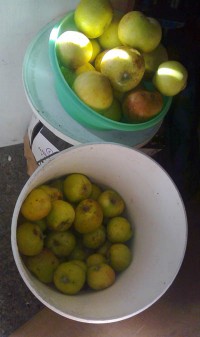
preserved apples
Keeping apples in a sealed bin can preserve them for months