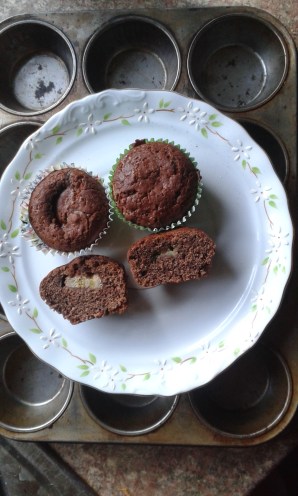
Most of these special seasonal fairy cakes have a nice chunk of banana in the centre – but some have vegetables!
You’ll need a baking tray that holds a dozen cupcakes, paper cases and a few precooked vegetables. I used some chunks of baked squash and some broccoli florets lightly cooked until the stems were just going soft. For the rest:-
4 ounces butter
4 ounces sugar
7 ounces self raising flour
1 ounce cocoa powder
2 eggs
a few drops of vanilla essence
a couple of tablespoons of milk
a banana cut into six pieces
some chunks of cooked vegetable about the same size as the banana – I used squash and broccoli, but small Brussel sprouts would be good too!
Turn the oven on to gas mark 5 (190 C; 375 F) to preheat it, make sure there’s shelves just above and below the middle.
Cream the butter and sugar, beat in the eggs and vanilla. Fold in the flour and cocoa, adding a bit of milk if the mixture is too stiff to work easily.
Dollop a small spoonful of mix into each cake case, spreading it to cover the bottom. Lightly press a chunk of banana into half of the cases, and a piece of vegetable into the other six. Carefully cover these fillings with the rest of the mix until they can’t be seen.
Cook on the higher shelf for 20 minutes, then move to the lower middle shelf for another 5 – 10 minutes till the cake tops are firm. There’s extra moisture in the fillings, so they take a little longer than usual. Take the cakes out of the tray and leave them to cool on a wire rack.
You might want to use colour coded paper cases to avoid ambushing yourself with a broccoli cake!
Iodine is important in the thyroid gland, which produces hormones affecting the entire body. A lack of iodine can stunt mental and physical growth in children; it causes a variety of symptoms in adults. Goitres – where the neck is swollen from an enlarged thyroid gland – used to be common in certain areas. The provision of iodised table salt has helped eliminate this uncomfortable problem.
The thyroid is a temperamental part of your body. It can be overactive; this makes you ill as well, and can be brought on by an excess of iodine. The USA recommends a daily intake of 0.15 milligrams (150 micrograms) for adults. Most people in developed countries take in more than this RDA, around 0.25 to 0.4 milligrams. In Japan, where the diet is full of iodine-rich seafoods, people can be eating up to three milligrams a day. One milligram a day is generally considered excessive though.
The effects of too much iodine are most pronounced when suddenly increasing your dose. This effect was observed in the salt supplement programme, and is a danger if taking iodine as protection against radioactive fallout. You should have a pack of the right type of iodine tablets in your emergency stores as speed is crucial to protect your thyroid, and they are quite hard to come by in Britain. ‘Thyrosafe‘ is recommended by some prepper sites.
The tablets need to be taken on exposure, and while the risk of breathing contaminated air lasts. They also protect your thyroid gland – and only this – against radioactive iodine from fallout dust in your food and drink. Iodine-131 and many other isotopes of iodine released by a nuclear accident decay over the course of days if not hours – hence the need for speed. By taking in clean iodine, you are preventing your body from taking up the poisonous sort. As your body excretes the unused portion, you have to repeat the dose every 24 hours until out of danger.
The risk from radiation will reduce over time; the pills may make your neck feel swollen and uncomfortable. There are other unpleasant side effects, even severe allergic reactions. The Thyrosafe ones contain 65 milligrams of iodine each, which is way over the RDA. You have to balance the dangers; the situation differs for children and the elderly. Have a packet of dried seaweed in your stores to keep up good iodine levels in an ordinary diet.
Don’t drink the sort of iodine you dab on wounds. This is poisonous tincture of iodine and not meant to be swallowed, though it can be used to purify water for drinking, as can bleach. Do some serious research before you try out any of these emergency life savers. Uninformed use can be harmful.
The Resilience Handbook is a book designed for the digital age. The information in it is tightly packed and depends on you getting involved with the suggested actions to unlock it. I’ve supplied a framework from which you can explore the wealth of knowledge available in the internet to fill in the details according to your own way of life, the options you have.
When I looked at iodine and radiation, researching for my next book, I learned that not all forms of iodine can be taken in by the body at all. There were a large number of ‘iodine supplements’ on the market. Many of the websites offering these for sale were full of cookies and pop-ups. I don’t trust these sites for information.
I looked down the search list and picked some more reputable sites to get the scientific version. The FDA have published ‘Potassium Iodide as a Thyroid Blocking Agent in Radiation Emergencies‘ which explored its use post-Chernobyl. From that information, I was able to refine my search, filtering down through survivalist sites to a market place and finally to a UK supplier. You’ll expect to pay about £35 for a ten day supply; half of that seems to be shipping from the USA.
For more information about emergency planning and food stores, read ‘The Resilience Handbook – How to survive in the 21st century’
It’s about time for another diary post, since it’s been a busy week here in Somerset.
Thursday was the Community Food Forum, an annual event organised by Feed Avalon. Around forty people gathered this year – its third – to network and exchange ideas. It was great to see projects like Plotgate, a community supported agriculture venture near Barton St David, developing from their initial fund raising to a successful business!
There seems to be a steady increase of interest in growing food, with new sectors engaging every year. This time there were people who work with mental health, where its therapeutic benefits are being recognised.
Saturday saw the Glastonbury Town Council hold a public consultation on possible uses for a splendid old building they have just acquired for the community. It would be ideal for a practical crafts centre; I’d like to see that combined with an ‘eco-college’ like Dartington Hall in Devon. We could explore local materials for textiles and ceramics – Somerset having a lot of wool and clay.
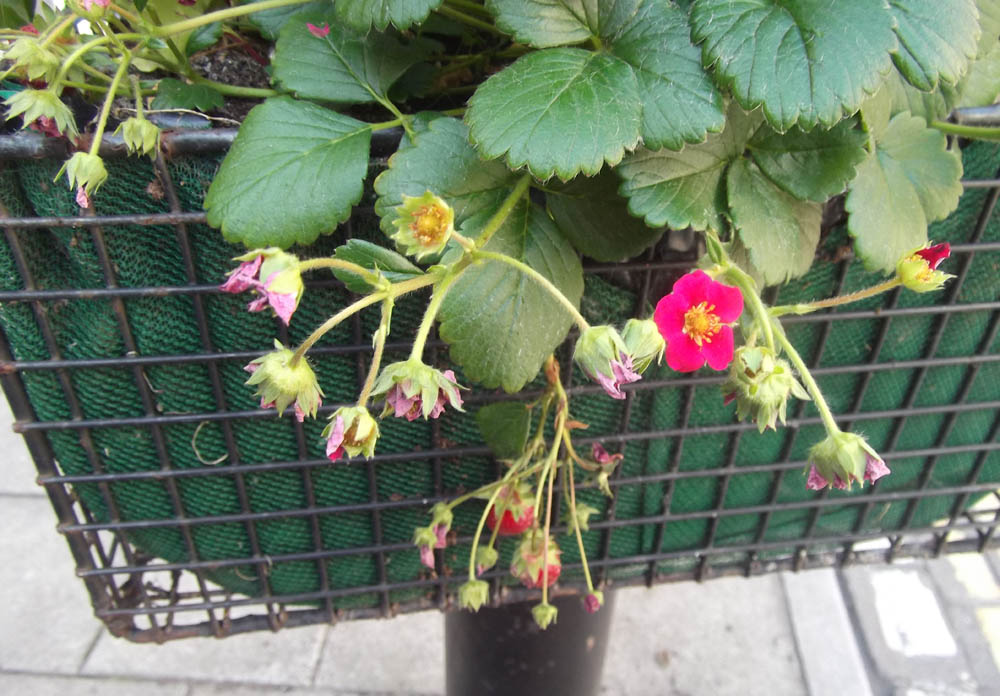
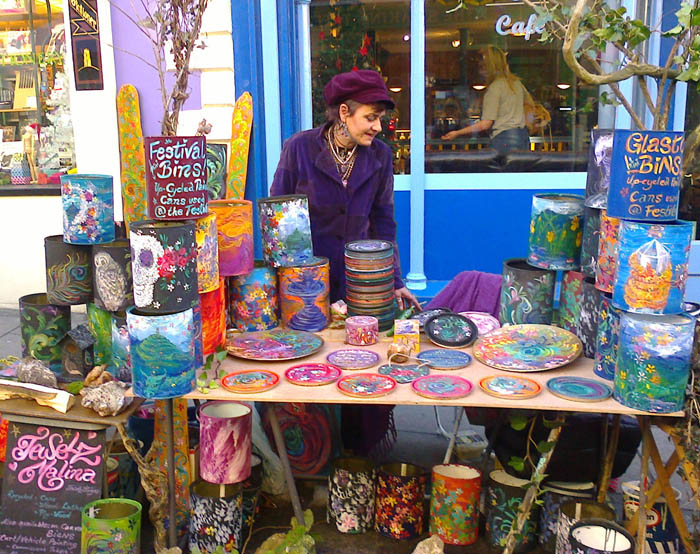
edible flower baskets in Glastonbury
In the evening, I went to the energy evening hosted by Green Wedmore. The purpose of the presentation and following debate was to explore future energy options for the local area. The range of these on the table was impressive. Not only solar, wind and hydropower, but also biomass from the surrounding RSPB nature reserves and anaerobic digestion using farm waste.
Vince Cable, former business secretary, gave the introduction and Pete Capener from Bath and West Community Energy provided an inspiring talk on how the renewables industry is adapting to a hostile government. I chatted to a long-serving member of the parish council, who’d recently had an impressive 16Kw array installed on the roofs of her farm buildings – using panels built in Wrexham. We snacked on excellent smoked trout vol au vents from the nearby aqua farm. The people of Wedmore intend to take quality with them into their sustainable future!
Someone had brought a particularly backward article just published in the Times. After spending much of the last forty years off grid, I view people who harp on about ‘the lights going out’ with the same astonishment as I’d view a flat-earther. Lights are easy. Washing machines, even freezers, are well within the scope of a modern personal renewables system without mains backup.
Tumble driers now, you could have a point. It’s not such a rousing battle cry though – ‘without nuclear power, you might have to actually hang your clothes out to dry!’
Meanwhile, the smart consumer is considering the benefits of making their own electricity…..
The best way to start this process is by looking at the devices you use already, and finding out how much electricity they use. In the Energy chapter of the Resilience Handbook, task eight asks ‘can you calculate how much of your home could run on a supply of 2 kilowatts?’ This level of supply is not only possible with a personal solar array, but designed to use a small ‘suitcase’ generator as emergency backup. ( More power requires a larger, noisier generator.)
Once you know the answer to this question, you’ve got a much better idea what local energy can do for you – it’s more resilient than a centralised power supply!
For more information about food and energy resilience, read ‘The Resilience Handbook – How to survive in the 21st century’
It was a glorious autumn day, dry and sunny. The rows and swirls of colourful stalls filled the grassy spaces around the ancient stone walls of the Bishop’s Palace, spilled over into the antique Recreation Ground next door, surrounded its bandstand and carried on down the lane, where our Food For Thought marquee was.
The venue looked splendid, thanks to the lovely Laura and the Wells food group team. It was decorated with vintage bunting, lit by electric chandeliers! After an early set-up, there was a little time to wander among the booths outside admiring the huge variety of local produce on sale.
My advice – go there hungry, and with plenty of spare cash! I couldn’t resist the Gilbert and Swayne chocolates, each one a tiny work of art. Some huge chunks of fudge for another birthday present – I sampled the Marmite flavour, which was not at all awful. Then it was time for the show to begin and the 15,000 visitors to start exploring.
We were so busy that I didn’t manage to photograph the enormously entertaining Human Fruit Machine, nor even get to the cordon bleu cookery on a budget demonstrations at the far end of our tent. I spent the whole day chatting about food resilience to a stream of fascinating people. I learned that people in London still don’t have much to do with their neighbours, that mountain sheep in Snowdonia have their own culture passed down over generations. We discussed Tyre Gardening with pictures and I gave away all my ‘fourteen day stores’ recipes/ingredients leaflets.
It was a great day out, an excellent start to the Wells Festivals season!
Thanks to Sean and Elliot, the visiting chefs from the Ale and Oyster, Ventnor for the leftover pasta dough from the workshops – I managed to cook real pasta for the first time back at home!
Knowing that you have fourteen days’ supply of food gives you confidence in a situation where supplies are interrupted, or you can’t use the roads. You may not be flooded yourself, but the way to the shops could become difficult. Give the emergency services space and stay in, living well from your stores!
They’re also useful for unexpected dinner guests – and for those who suddenly announce they are vegan!
Storing food is an ancient human habit, taking advantage of a surplus to get your tribe through leaner times. The range of storage methods available to us today are considerable, yet fewer people than ever take advantage of them. The most popular strategy seems to be stocking up on frozen ready meals, then zapping them in the microwave. No actual cooking involved.
Is this resilient? Of course not.
In an emergency, the mains electricity may fail. After a few days, your freezer stores will be turning into a waste disposal problem. There could be extreme weather outside which forces you to stay at home. You need a back up.
Tinned and dried foods keep well, even in challenging places such as your loft or shed. Only store what you’re prepared to eat. These stores will need to be rotated as they go out of date. Your survival recipes should be planned to incorporate any other food which might turn up – garden produce, a delivery of rations, a community food share.
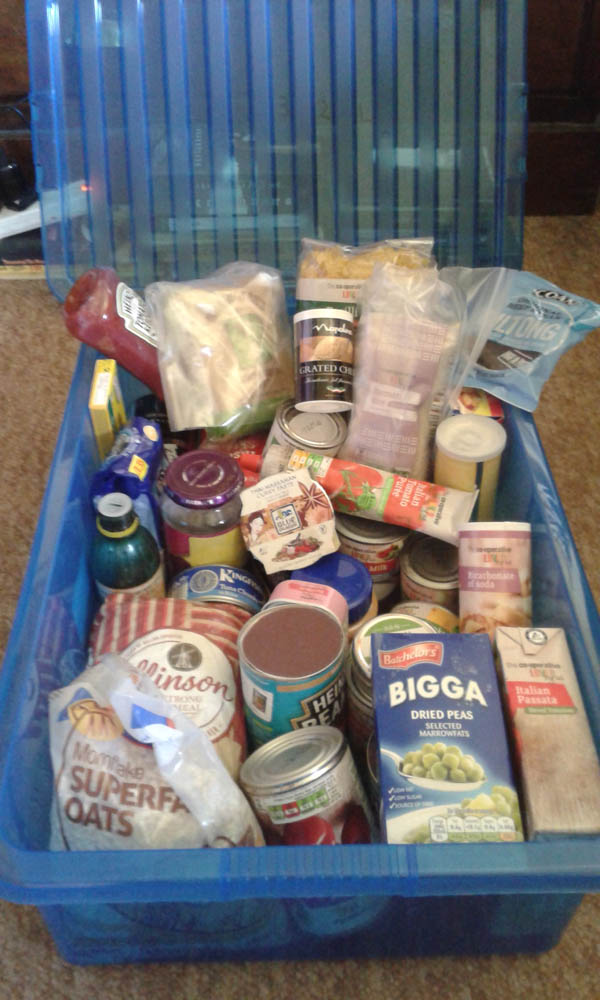
This 32 litre stack box fits under an average bed and contains enough supplies to last a fortnight. Porridge for breakfast, pan bread if you’ve no oven, a selection of stews and curries. I haven’t calculated the calorie intake, or added up grams of carbohydrates, just worked out a sensible meal plan covering all the food types.
There’s a more scientific estimate here. “4.9 kilograms of cereal-based products like rice, bread and noodles per person per fortnight…… 5.6kg of veggies, 3.7kg each of milk products and fruit and nuts, and 2.1kg of fish and meat.” It seems like a lot. Might not fit under the bed, and remember you have to find space for all the water as well.
A fortnight’s worth of emergency supplies can be a valuable asset to a household. Using a selection of your normal foods, as pictured, you have a back up when you run out of tomato ketchup, milk, beans, coffee. You can restock as these foods come on offer!
These stores are tailored to my preferences; what would you keep? Remember that, in an emergency, you may not have mains services. Stick to recipes which can be achieved on a camping stove (have you got one?), or even an open fire. Learn about Dutch ovens, understand the principles of cooking and how you can use ingredients inventively.
For more information about emergency planning and community resilience, read ‘The Resilience Handbook – How to survive in the 21st century’
This exhibition of food stores will be on display in the ‘Food for Thought’ venue at Wells Food Festival Sunday 9th October, 10 am – 4.30 pm, where I’ll be chatting about resilience and signing Handbooks!
So…Britain voted to leave the European Union, and what sore losers the Remainers are turning out to be. Despite claiming the compassion corner, the vitriolic hate spewing out from many would do credit to any xenophobe.
In the countryside people are still stunned that their concerns have finally been noticed by city folk. They shouldn’t relax. Already there is talk of ‘not really leaving’ and murmurs of ‘punishing the rebels’.
While this acrimonious debate rages, we’re all still buying food, clothes and gadgets. It’s never been so important to target your spending at British products. Money spent in the country stays in the country and enriches it. Our economy needs that boost from ground level right now.
If you shop in a supermarket, take a little longer and read labels. Find out what we actually make here. Try going for ingredients rather than ready-meals of dubious provenance. Spend a few pence extra to buy local vegetables, meat and dairy. The country of origin is on all packaging.
So is the name of the supplier. When you get home, go online and check out the firms which make your favourite foods. Can you buy a similar product made in Britain? What about clothes? Gadgets and services? Every little helps, they say, and it does.
Seventeen million people voted to leave the EU. If each of them made the effort to spend an extra £10 with locally owned businesses this week, it would add up to well over 2% of the entire weekly turnover of the retail sector. Joined by remainers and non-voters, just a tenner a week each adds up to 6% of this turnover – close on £500 million.
It wasn’t just the European Union who encouraged multinationals to mop up small independent businesses. Your consumer choices also helped shape this situation, and they can act to change it.
Take back your power – bring in strategic spending!
for more about bringing prosperity back to your area, read the Resilience Handbook
This link takes you straight to me at my desk, where I sign the book and send it off. All the money goes straight into my account to be spent in local shops. If you prefer familiar labels, you can buy it at Amazon, where I eventually get some kind of pittance. Your choices certainly matter to me!
I expected June to be a quieter month than it usually is for me, as I’m not going to the Glastonbury Festival for the first time in many years. There’s no going against the rhythm of the seasons though, and events conspired to make this month every bit as hectic as before!
I’ve been working hard on my next book, about food and resilience…this involves a lot of experimental cooking and field studies. We finally got an allotment garden for our project; it’s quite overgrown. Although late in the season, we’ve managed to plant out the last of our seedlings, and there are quite a few food plants there already which only need the undergrowth cleared away.
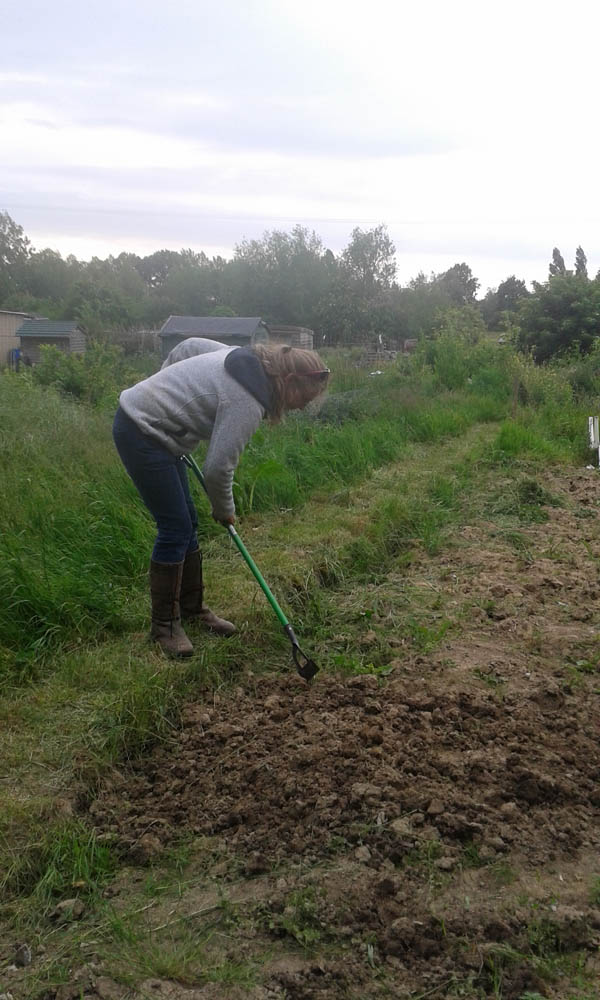
Linda hoeing our new growing space
It was the Green Scythe Fair on 12th June, which is an annual fixture for me. Strolling among the colourful stalls is like visting a future where everything has worked out fine. People gather around to admire the latest electric car on display, discuss the merits of the various tools offered for sale, consider hand made clothes or choose a pair of angora rabbits to breed for wool. The faint tap of peening scythes underscores the murmer of conversation. A woman plays her fiddle while children dance; other youngsters make nests from the cut grass.
A tremendous selection of local delicacies are to be sampled here, from crystallised flowers to venison steaks.
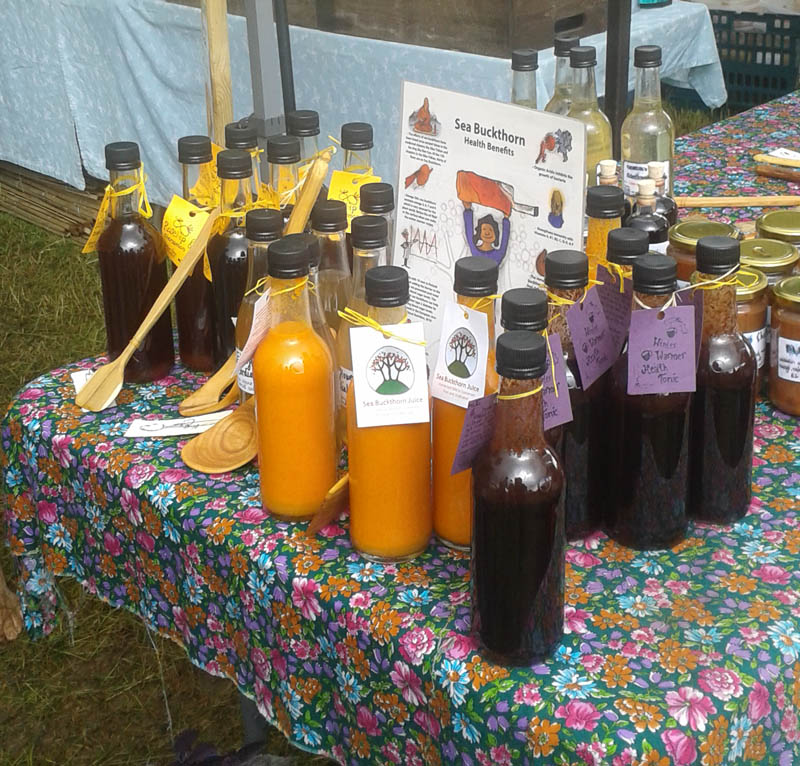
A stall selling juice made from sea buckthorn
You can get anything you can think of to do with honey, including a hive of bees. All the brand names, the shiny labels, are absent though. The cafe heats its water by wood-fired rocket stoves; the electrical power is from storage batteries recharged by renewables, including the lights and entertainment at night.
In the Craft area, one can see blacksmiths, stone masons and thatchers at work. There’s a stall selling hemp twine, another with leather pouches. A man haggles for an enamel basin, a woman picks a new copper kettle. The plough horses watch curiously as you pass by; yesterday they were demonstrating techniques for a land workers’ training session.
The centre piece of the event is the scything. A grand marquee is set up like a scything supermarket, with blades, whetstones, files, all the odds and ends of the craft. You are ‘fitted’ for the right size of handle, consulted about the appropriate blade and shown how to attach it. The complete novice is given a introductory pamphlet, but it’s wise to enrol on one of the day courses. Like any skill, it’s best learned alongside a master.
On the day of the Fair, however, all these craftspeople were out on the long grass in the centre, where the competitions were taking place. There were trophies to be won, reputations to be made! A sudden downpour had flattened much of the grass – how would this affect the form? The skilled scythers – men and women in separate heats – would cut their allotted square down to the length of a well trimmed lawn in only a few minutes. Assistants raked up the fallen grass while the judges inspected the quality of the job and considered points.
After the business of the day was done and the cups awarded, the music and carousing began in earnest. The stalls closed up and stole away; the families left. Only the crafters and campers were left to wind the evening up in traditional style and wobble gently home across the dark, empty fields.
March seemed to be a busy month, though I couldn’t exactly say how. I built a new tyre garden on a derelict car park, harvesting a windfall heap of spent mushroom compost donated to the Red Brick Gardening Club. Once there’s a few dry days, I’ll paint labels for the plants and take pictures.
Gardening was the theme – the long wet winter has delayed planting as the soil here was too cold and wet. Seeds tend to rot in those conditions. A greenhouse would have been useful to me; my neighbour has one they don’t use much. The issue would be access for watering.
I gathered bags of the compost to fill up my own raised bed, made a trip to the seaside for seaweed, and finally began the planting. Leeks and broccoli are the staples; carrots grown in large pots with extra sand. The broccoli is from saved seed, but I’m still having trouble getting viable leek seed.
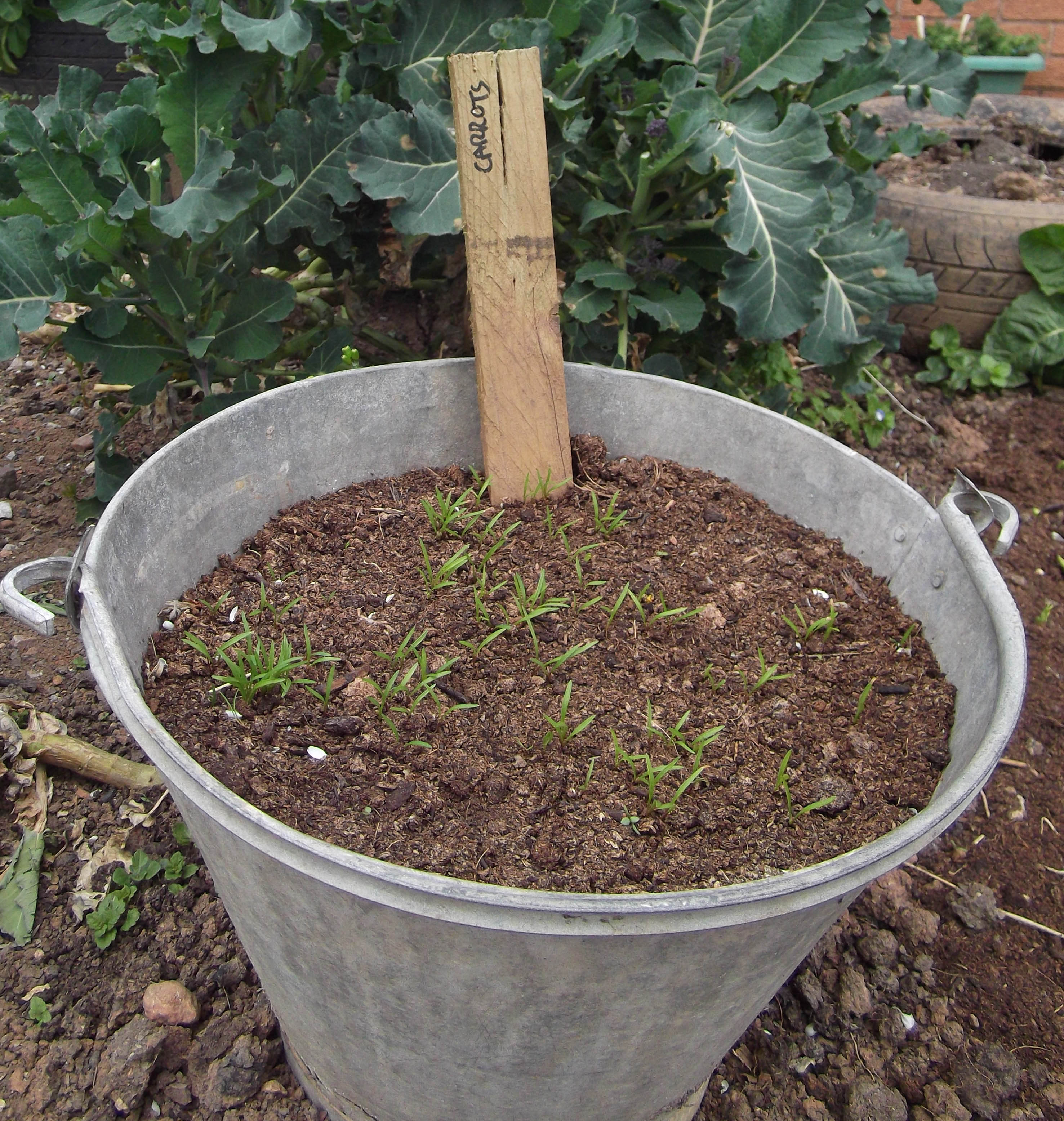
carrot seedlings in sand with a background of mature broccoli leaves
I’m planting Valor seed potatoes in the ground, and Stemster in tyre stacks. The peas, soaked for a few days and beginning to sprout, have been buried beside their climbing frames. I’ll buy in tomato plants and squashes this year. They need that head start to be ready by the end of summer. There’s only so much green tomato chutney a household can eat!
I’ve been out with the Resilience Handbook a few times too. Earth Hour in Chard was splendid, if bitterly cold. Chard has an interesting history; industrial rather than farming, unusual for Somerset. The Magic Oxygen Literary Prizegiving day in Lyme Regis was excellent, like a miniature Literary Festival! I gave a talk on food resilience, which went down well.
In between outdoor work and excursions, I’ve been working on my new book ‘Recipes for Resilience’, plus designing some talks and workshops. I’ll be talking at the Green Wedmore meeting tonight. I haven’t been out on an adventure for awhile now, so I’m planning a trip to the furthest south west – the Scilly Isles – promoting the Handbook and looking out for resilient recipes!
It may be hard to summon up the Xmas spirit this year, but your spending power is still a lifeline for independent businesses. Make someone’s day and buy from their small shop or market stall!
Traditional crafts are struggling to stay alive, despite their key role in a resilient society. The few people who persevere have to price their goods at the luxury end of the market to compete with factories. They need your custom more than the supermarkets do, and give far more back. Choose your loyalties.
Half the total Xmas spend is on gifts – in Somerset for example, this amounts to about twice the County budget. Some of these will be specific large items, but a lot will be trinkets, small presents, Secret Santas. Write a list, then go out exploring. See what you can find at craft fairs, visit interesting little shops.
Stay organised – find a box to store your purchases. Don’t lose track and buy something twice in the last minute rush!
Soaps, socks and chocolates are good standbys. You can wash your hair with most hand made soaps (unlike factory produced ones); well made socks can be repaired by darning. You can buy chocolates that are like tiny works of art. It’s a gift; it’s the thought that counts, not the weight. Buy quality.
You can use scraps of pretty cloth and handmade cords as wrapping – all reusable!
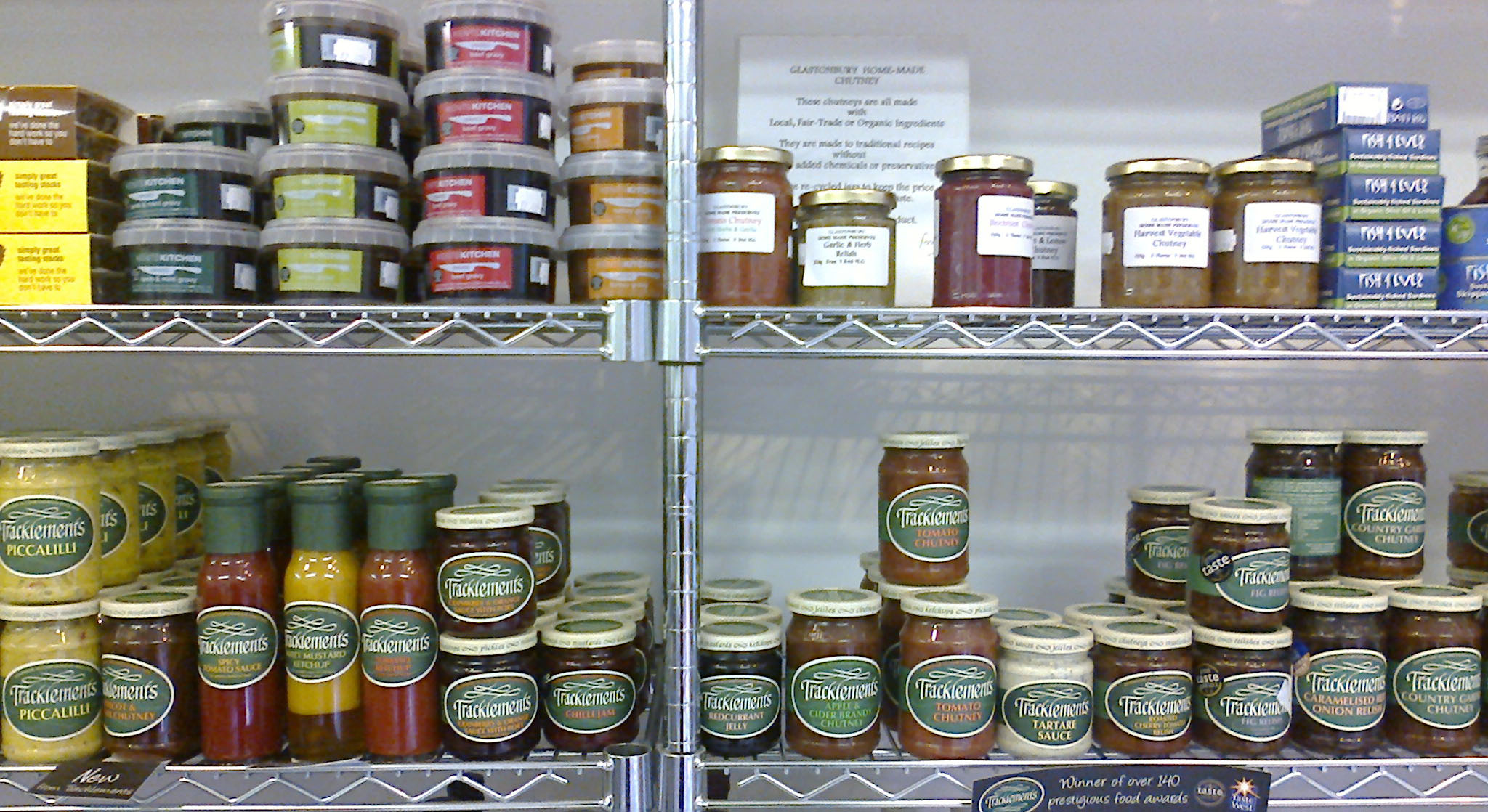
Another third of the Xmas spend goes on food and drink. Another chance to sample quality produce; treat yourself! Farm shops often sell chutneys, jams and pickles. Christmas cakes keep for weeks and are often on sale at markets. Consider making your own mince pies.
The best way to buy your Xmas dinner is to order fresh locally reared organic meat from the independent butcher. If you’ve never done this before, consider there may be a bit of a queue on collection day. Bring an umbrella, a newspaper, be prepared to chat to people, live a little slower.
Spend your Xmas surrounded by food, drink and gifts which that have meaning, not just labels. Start planning now!
There was so much going on at the Food Sovereignty Gathering, that there was little time for me to explore the Hebden Bridge area properly. I’d taken a chance mentioning it in the Resilience Handbook (p86) on reputation alone, and wasn’t disappointed.
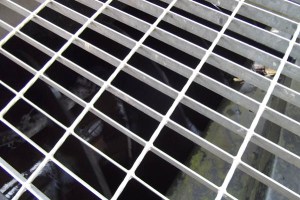
The Archimedes screw at Hebdon Bridge
The movement itself turned out to be too concerned with international affairs to really connect with the firmly local criteria of resilience. I met some interesting people and had many productive discussions however.
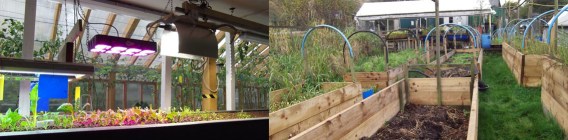
In among the demanding schedule were visits to the key features I wanted to see: the Incredible Farm and the Aquagarden in Todmorden, of which more another time.
The Gathering was quite tiring and I needed Tuesday to unwind. Our hostel, being on the Pennine Way, had a great interest in rambling, with a collection of useful maps.
I explored the Hebdon Bridge Loop of the Pennine Way in the company of Helena Paul (author of ‘Hungry Corporations‘). It was an eerie, misty day but the trail was well marked and we wandered up and down the landscape, often on paved ways which must have taken a lot of work.
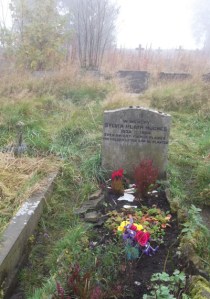
We called at Sylvia Plath Hughes‘ grave in Heptonstall; a place of pilgrimage for her admirers, who are accustomed to leave pens as gifts. It turned out to be the poetess’ birthday, and we learned the history of the site from a fellow author there. Nibbling on Himalyan Balsam seeds, we followed the maze of paths, challenging bullocks for right of way, pausing by the washing pools to look for dippers, and back along the river with its decaying industrial remains.
Off the next day through the nightmare of Manchester outer ring road, a four lane dual highway crawling along in second gear amid a fume of exhausts. This country overcrowded? You bet. The Peak District looks like a rock in a crusher. Arrived with relief at the Anglesey Outdoors hostel with its early morning kayakers. Rather them than me in those waves!
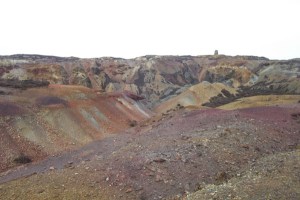
I drove along the coast and visited Copper Mountain instead. The mining operation which reduced this hill to a pile of toxic rubble ceased 150 years ago. All that grows in the sparse acid soil is heather, the only sound of life the occasional apocalyptic crow. It takes two hours to walk around the edge of this tortured landscape, among the rocks drenched with warped and twisted bands of colour, the heaps of pink scree.
Somewhere in the world this process is destroying another place of former natural beauty. The Internet – an enthusiastic user of copper – comes with a price.
Onwards and decidedly upwards along the west coast of Wales to the Centre for Alternative Technology. I’d been offline since Hebden, so failed to organise a meeting, but the Resilience Handbook I left was well received. I bought a ticket – valid for a whole year! – and explored this iconic establishment for the first time.
It has developed and expanded over the years to a full scale educational facility with over a hundred staff. The fascinating exhibits, set in a lovely natural landscape, cover the whole spectrum of resources from energy provision to waste disposal. I certainly need a return visit to take it all in!
I spent the night at the Corris Hostel just down the road, where the hostel manager organised a cook out in the forested garden. The visiting party of young singers fom Liverpool were entranced, even abandoning their smartphones to fry sausages and toast marshmallows!
The final stage of my travels took me via Swansea, to supply the nascent Resilience Project there with Handbooks, and so home to a welcome bath.
By using hostels and public transport, a single traveller can take an adventure break very cheaply. Families could pool transport and stay off season in a holiday camp. So it might rain? Adapt. Learn resilience. Everybody needs adventures.





 elizabethjwalker