Category Archives: Food

The Apple Juice Project – Part One

Somerset, famed for its cider, is still a good place to grow apples. Many gardens boast at least one tree, but few people are able to make full use of the fruit and it often goes to waste. Collecting spare fruit to make apple juice could be a resilient way forward.

So we collected bags of sound apples. They need to be in good condition for juicing, not bruised or chewed. We borrowed a scratter, a press and a pasteuriser from Somerset Community Food and spent the afternoon pressing apples.

Much hard work later, we had fifteen bottles to fill the pasteuriser, and some left over. Unpasteurised apple juice will only keep for a few days, even in a fridge. The pasteuriser sat on a chair in the kitchen, full of very hot water, for several hours.

Although the juice did keep well – we opened a bottle eighteen months later, which was fine – it had taken a lot of apples and hard physical labour to make not very many bottles. If ever a process called out for mechanisation, this was it.

We knew a local firm would take apples and press them into juice for a fee, which no longer seemed so unreasonable. It would be possible to make a profit of £1 a bottle. Could this finance a larger project?

This year, we explored Plan B. Collecting fruit from an overgrown orchard in West Pennard, we estimated that one tree provided enough apples for one crate of the five needed for a minimum order. Two people took an hour to clear the ground of rotten apples and windfalls, then pick the good apples from the tree.

The profit margins are too small to offer the householder free apple juice, and you must be careful how much you sell at cost. Most people who have unused fruit trees, though, are pleased to have the ground underneath them cleared. Fallen fruit attracts wasps, is slippery and interferes with lawn mowing.

People already doing gardening work could combine this with harvesting the apples. A cider company might buy the windfalls, increasing the profit margin. Careful planning of collection rounds can minimise fuel use.

One crate of apples gives you about 12 bottles, from which you need to pay for your fuel and the time spent selling the juice. You would need to invest the money in having the juice made, and maintain a small van. It should be possible to earn a small living from the wasted apple harvest for one quarter of the year though.

The project may be a good income for a community group using volunteer labour. They would have the added benefit of being able to access a market, funding for a pilot scheme and better publicity networks.
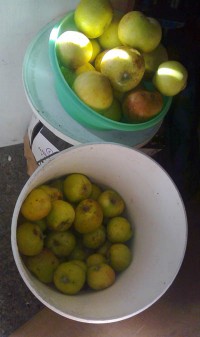
 

preserved apples
Keeping apples in a sealed bin can preserve them for months

What is Resilience?

It’s not easy to explain or define ‘resilience’ even though it is becoming the new buzz word. Simply described, it is the ability to cope well with change. It can be applied to materials, ecosystems or entire planets, but here we are dealing with resilience in people, in communities and in cultures.

Resilience is a concept with depth, one that exists and develops through time, like loyalty and responsibility. It implies a knowledge of what is valuable, what must continue, where to strive to repair and regenerate, what should not be discarded.

Change can come in many forms. The fossil fuel bonanza of recent centuries has enabled people to become detached from each other and pursue their individual desires without reference to local resources or communities. As a consequence, these communities and resources are no longer available to support us through the next major change as this cheap and abundant – but not renewable – fuel begins to run out.

‘Peak oil’ is the term used to describe the point where new fossil fuel discoveries no longer compensate for the steadily decreasing production of existing oil fields and coal mines. It does not mean the end of fossil fuel. There is still time to adapt to a sustainable lifestyle, a change which will be driven by the increasing cost of energy as this source becomes more scarce.

Resilience and sustainability are closely linked. As an unsustainable practice is doomed to eventual failure, it is not a resilient practice either. Sustainability tends to start at the luxury end of the market and work downwards while resilience focusses on need and works upwards.

Sustainability asks “could you involve less air miles when choosing which food to buy?”

Resilience asks less comfortable questions such as “how much food can you access within walking distance of your home?”

Think about that last question. In what circumstances would it become important? Is your local food supply enough to sustain you and the people in your area? For how long?

You fill up your car, you drive to the supermarket, you buy food. The whole process takes hours at most. Growing food takes months, requires land, needs work. Waiting until a global situation outside your control disrupts the fragile transport network upon which we depend will be too late.

Our lifestyle is far from resilient and we need to act now to correct this. We must take control of the process of change and turn it to our advantage.

The Resilience Garden Open Day September 2013

The Resilience Garden Open Day September 2013

The Resilience Garden project develops ordinary gardens to provide an emergency supply of fresh food for the immediate neighbourhood. A significant amount of home grown food for the householder all year round is a useful side effect.

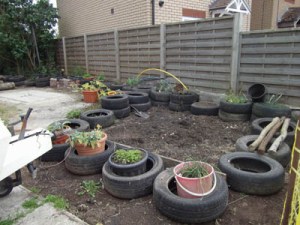
This garden, in Coxley, was built using reclaimed materials, at very little cost. A raised bed system is used as the local soil is a heavy clay, difficult to raise vegetables on. The growing area was created in stages over five years, using tyres as a retaining wall to enable easy expansion as soil became available.

It took quite a lot of soil to get a good depth in the vegetable beds. This was mainly reclaimed from building sites. Structure was added by mixing it with kitchen waste and manure. A home-made spray of comfrey, nettle and seaweed provided extra minerals. All the food is grown using organic methods and applying permaculture principles for low maintenance.

The garden was in a useful state of transition for the Open Day as the initial tyre layout had reached the final stage; the shape and size of the plot was now fixed. The tyres were being emptied and replaced by a low brick retaining wall. The higher stacks on the windy corner were still in place, demonstrating how versatile these temporary structures can be.  When the permanent wall is complete, willow hurdles will provide a wind break.

A new bed was being formed on the other side of the garden, using the old tyres to surround a patch of gravel ready to fill with soil. An edible green manure, such as rocket or cress will be planted there by the end of September

new-garden-13-3

Despite the cold rain setting in about lunch time, we had a dozen visitors over the course of the day, all of whom braved the outdoors to explore the garden. The plant identification game did have to be abandoned and the workshop became a lively kitchen table discussion, but all told, it was a good day!

Gardening for Resilience

Convert your garden into a year round food supply!

 Open Day at the Resilience Garden is on Sunday 15th September from 11 am to 5 pm at Harters Close in Coxley, Somerset. Entry is free as part of the Incredible Edible Somerset Open Gardens Day.

Visitors will have the opportunity to test their skills at plant identification and there will be a talk on community resilience at 2 pm, with demonstrations of useful and easy to learn crafts.

Save money, keep fit and be prepared

A visit to the supermarket, even for a pint of milk, rarely leaves you change from a £20 note, it seems. Shopping carefully on a budget, you’re better off only having to go there once a week! Having fresh vegetables to hand just outside your back door cuts down those extra shopping trips, as well as being healthier and involving no food miles at all.

Gardening is a good excuse to spend some time outside, taking gentle exercise. Modern no-dig techniques take much of the heavy labour out of maintaining a garden. Using home made organic fertilisers and recycling your food waste as compost reduce costs while companion planting and a healthy soil cut the need for expensive pest control products.

In the event of a national emergency, through extreme weather or hostile actions, our delicate and extensive food transportation network could be badly affected for some weeks. Rural areas could become isolated and dependent on limited stores. There may be no electricity, which would destroy frozen supplies and force reliance on tinned and dried food.

Growing your own would help your community through this, by providing a small but necessary amount of fresh produce with its vitamins and minerals.

Image

 Learning how to survive in the 21st century

The Resilience Garden is one of a series of projects designed by Elizabeth Walker, a teacher and writer with many years of experience in living ‘off the grid’. Her Resilience Wheel concept links all the factors necessary for a robust and sustainable community based economy into a single framework. No positive effort, however small, is wasted and everyone can do something straight away to bring a better world closer, while saving money and improving their quality of life.

She trains volunteer event stewards in emergency procedures during the summer, organises workshops around adapting traditional crafts to the modern world, and writes educational materials, articles and stories set in strange landscapes.

For more information on the Open Garden or on planned courses with Carymoor Environmental Centre and Somerset Skills and Learning, please follow this blog.