Category Archives: resilience

Driving in the Water Margins

Here on the levels in Somerset between the sea and the high ground we’re used to seeing the water. Driving between towns, the fields are shimmering mirrors, traced with sunken hedges, populated by opportunistic swans. The main roads are edged by dark puddles, threatening to merge over the white line with every fresh downpour.

Villages hugging the tiny ridges of high ground out in the marshlands are often cut off. Farm tractors become informal delivery vans and buses. Rows of willow trees, planted so that people can see where the road was, come into their own. The river lurks just over a low bank.

The network of narrow lanes across country are under water in many places, especially at the crossroads and gateways where you could have turned around. If you come upon one flooded section, chances are there are more ahead. It’s unwise to use these lanes as a short cut.

Towns are linked by single main roads. An incident on one of these could involve you in a twenty mile diversion just to get back from the shops. If that route then becomes blocked – easy enough with the high winds and dangerous conditions – hundreds of people could become stranded for hours.

Keep at least half a tank of fuel, even for local journeys. Carry waterproofs, wellies and a drink of water in your car. Make sure your mobile phone is charged.

Shop with a list and bring in extra long life food. Try to avoid going out at all in heavy rain. Start using all those ready meals in the freezer; if your electricity goes, they will be a write off anyway.

Night time is the most dangerous. Plan to stay in, invite neighbours round, play cards or games, learn to knit. Spending all your evenings slumped in front of the TV will soon give you cabin fever!

Driving through flood water is unwise, especially if you are on your own. You can’t see how deep it is, if the road has been washed away underneath, if there are any obstructions ahead. Your electrics may get damaged.

Don’t change gears but drive slowly and steadily. If your engine cuts out, it may have got water in it. Trying to restart it might destroy it.

Even six inches of fast moving water can sweep you off your feet, and not much more can move your car. If you become trapped in a flood, call for help at once. Don’t panic and think very carefully about your escape route.

Resilience is about adaptation. Change your behaviour in response to the environment. Go out as little as possible and make every journey count. Even if you’re not directly affected by flooding, you could still be caught up in a diversion as police try to clear another area. Your presence on the road is one more factor for the emergency services to take into account, so don’t waste it.


Roast dinner and leftover stew

You’ll find that collecting vegetables from the garden adds to the preparation time for a large meal. They need to be dug up, washed and trimmed. You can economise on effort by cooking more than you need and adding the surplus to a stew the next day.

Buy a bird or joint for a roast dinner. You can afford organic free range, as you’re going to be able to get up to twelve adult meals from under £10 worth. While it is cooking, use the oven to roast trays of potatoes, onions, parsnips, carrots and squash – whatever you have available. Keep enough room for a tray of Yorkshire puddings to go in later.

Timing is crucial. Wash all the vegetables. The meat will take longest to cook, so put it in first. Read some recipes for more exact times. After the meat has cooked for awhile, the roast potatoes are next. Put them on the shelf above the meat until they start to brown when you can move them lower. If you get fed up waiting for this to happen, you might be able to finish them off under the grill. Don’t forget they are there.

Make a Yorkshire pudding mix using one egg, two tablespoons of plain flour and four fluid ounces of milk. It needs to stand for at least half an hour before cooking. Longer is better.

Prepare the vegetables for roasting. They can go in when the potatoes are getting soft nearly to the middle. You could move the meat down a shelf now. Do use hand protection when moving hot oven shelves, always take the trays off and set them on a heat proof surface first, and be careful of hot oil.

Cut up some cauliflower, shred brassica leaves, spinach or chard ready for steaming on the hob. Take your Yorkshire pudding trays, add a teaspoon of oil in the bottom of each and put the empty tray near the top of the oven for the oil to heat up.

Check the progress of the other things in the oven. The meat should be nearly ready to take out and the vegetables almost edible. If not, this is a good time to tidy up. When everything else is up to speed, take out the trays and carefully add a couple of tablespoons of the batter mix to each. The above amounts should make six, just share it around, they don’t need to be very full. Return them to the oven, near the top. Start steaming the vegetables.

The idea is to smother everyone’s plate with vegetables so that they do not notice there is only a small piece of meat each. The Yorkshires are for filler, and if you can make a thick gravy using the juices from the roasting dish, so much the better.

Hide the rest of the meat, or otherwise ensure no-one is going for seconds or midnight raids. There should be a mixture of vegetables left over. Keep these for the next day’s cooking, when you will be making leftover stew, possibly with dumplings. If you bought a bird, you can make a stock with the carcass and use this as a base for a broth on the third day.

An expanded version of this strategy, along with recipes for vegetables, has been included in ‘Recipes for Resilience’, to be published in 2018.

Mince and Barley Broth

This is incredibly cheap and can be put together in minutes, then left to cook while you do other things.

Use a large pan. Take a half pound (about 250 grams) of mince, preferably from your local butcher, and brown it in a little oil. A dash of soy sauce at this stage improves the colour. Add a couple of finely chopped onions, herbs and garlic.

Stir till the onion is soft, then lightly sprinkle with plain flour and stir some more. Slowly add a litre of hot water as you stir, then crumble a stock cube into the broth. Throw in a couple of handfuls of dried barley grains and simmer on a low heat for at least half an hour, stirring occasionally.

Serve with bread. This broth provides a nourishing meal for at least four people.  Increase the quantities to feed more.

At this time of year you will find that your stored potatoes begin to soften and sprout. Soon they will no longer be a reliable source of carbohydrates and the resilient household will need to turn to grains.

The leeks you planted last year will be ready to use now, and can be substituted for onion in this recipe. For extra vitamins, add shreds of new brassica leaves or throw in a handful of chopped wilted rocket just before serving. Use up the last of the potatoes, carrots and parsnip over the Spring to bulk the broth up into a stew.

Dedicated survivalists can, of course, strip the meat from a lightly roasted rabbit or squirrel and make a stock from the carcass instead of using mince and hot water.

What is ‘Transition’?

The Transition movement takes a positive attitude to the changes we will need to make in order to cope with the end of cheap oil.

With the price of fuel, you may not feel that oil is cheap in any real sense, but for operating machinery, running factories and processing other natural resources the power of fossil fuel was incredible compared to that of manual labour. After centuries of runaway technological growth, we are finally arriving at the point where advanced machine design and renewable energy sources can replace the use of oil, and just in time as it is becoming harder to obtain.

The infrastructure, and to some extent the lifestyle, created around fossil fuels needs to change. The Transition network is dedicated to supporting this process. Totnes, in Devon, became the first ‘Transition Town’ in 2006, and many others have followed.

A Transition Initiative looks at forming an energy descent action plan for their area, exploring how local resources can be used in a more sustainable model, and outlining the path of this transition. As life with lower energy consumption is inevitable, it is best to plan for it and Transition maintains that the increase in quality of life will more than compensate for any inconvenience.

The Transition movement has local branches all over the country. Transition is ‘an invitation to join the hundreds of communities around the world who are taking the steps towards making a nourishing and abundant future a reality’

Rob Hopkins, The Transition Handbook


Community Resilience and Emergency Welfare Newsletter

C.R.E.W are borrowing space here to post their steward newsletter until they can sort out a new website; however this coincides with some exciting changes in their organisation…

“Hi to all our loyal and fabulous volunteers!

Wishing you all a merry festive season!

We have rather suddenly got a new email address crewcic@gmail.com since the locally based Ergonet hosting company went bust – please direct all stewarding enquiries here for the moment and we will let you know if this changes. They wouldn’t let us send out this newsletter.

We’re seeking funding for a new website, which will come with a proper email address.

We’ve now become a Community Interest Company so that we can develop more of our resilience courses and practical skills camps. We’ll still be running stewards at One Love next summer, but not the Green Gathering. However, we are recruiting people for traffic management at the Langport Scythe Fair in June, and are looking for small event work especially in Somerset.

For next year, we’re planning low cost resilience training courses in France, the opportunity to meet up at an established camp and various hands-on craft events, among other things. We’ll send out a more detailed newsletter in the New Year.

As we are now a proper company we are building up a stock of useful items and local craftworks for sale to raise money for providing training in all aspects of resilience. For example….

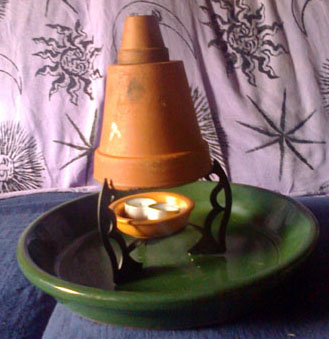
Candle stove (as seen on Facebook except this one has been researched and tested for the past year)

 new design 72ppi

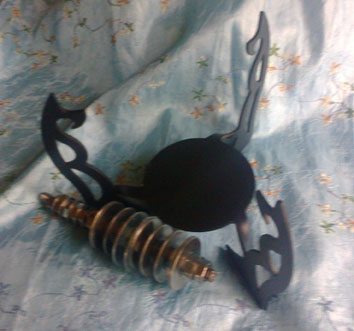
 The key features are the stainless steel core and the metal stand, which we can supply for £25 (Stand £20, core £7.50 sold separately) with full instructions.  Contact the temporary gmail address above for details

 new stand and core 72ppi

Resilience Handbook a 32 page A5 booklet with the basic outlines of the Resilience Wheel concept, as seen on our now vanished website, which is £3

Both items are post free to our volunteer community!

Our Facebook friend page CREW HQ regularly posts interesting and useful ideas around resilience and sustainability, please do join us there!

Cheers

Jane & Helene (Directors)

Linden (Secretary)

Linda (Consultant)

Simon (Marketing)”


The Apple Juice Project – Part One

Somerset, famed for its cider, is still a good place to grow apples. Many gardens boast at least one tree, but few people are able to make full use of the fruit and it often goes to waste. Collecting spare fruit to make apple juice could be a resilient way forward.

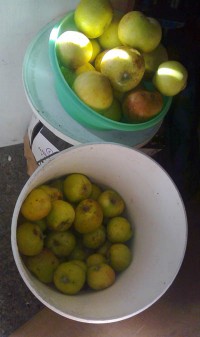
So we collected bags of sound apples. They need to be in good condition for juicing, not bruised or chewed. We borrowed a scratter, a press and a pasteuriser from Somerset Community Food and spent the afternoon pressing apples.

Much hard work later, we had fifteen bottles to fill the pasteuriser, and some left over. Unpasteurised apple juice will only keep for a few days, even in a fridge. The pasteuriser sat on a chair in the kitchen, full of very hot water, for several hours.

Although the juice did keep well – we opened a bottle eighteen months later, which was fine – it had taken a lot of apples and hard physical labour to make not very many bottles. If ever a process called out for mechanisation, this was it.

We knew a local firm would take apples and press them into juice for a fee, which no longer seemed so unreasonable. It would be possible to make a profit of £1 a bottle. Could this finance a larger project?

This year, we explored Plan B. Collecting fruit from an overgrown orchard in West Pennard, we estimated that one tree provided enough apples for one crate of the five needed for a minimum order. Two people took an hour to clear the ground of rotten apples and windfalls, then pick the good apples from the tree.

The profit margins are too small to offer the householder free apple juice, and you must be careful how much you sell at cost. Most people who have unused fruit trees, though, are pleased to have the ground underneath them cleared. Fallen fruit attracts wasps, is slippery and interferes with lawn mowing.

People already doing gardening work could combine this with harvesting the apples. A cider company might buy the windfalls, increasing the profit margin. Careful planning of collection rounds can minimise fuel use.

One crate of apples gives you about 12 bottles, from which you need to pay for your fuel and the time spent selling the juice. You would need to invest the money in having the juice made, and maintain a small van. It should be possible to earn a small living from the wasted apple harvest for one quarter of the year though.

The project may be a good income for a community group using volunteer labour. They would have the added benefit of being able to access a market, funding for a pilot scheme and better publicity networks.


preserved apples
Keeping apples in a sealed bin can preserve them for months

What is Resilience?

It’s not easy to explain or define ‘resilience’ even though it is becoming the new buzz word. Simply described, it is the ability to cope well with change. It can be applied to materials, ecosystems or entire planets, but here we are dealing with resilience in people, in communities and in cultures.

Resilience is a concept with depth, one that exists and develops through time, like loyalty and responsibility. It implies a knowledge of what is valuable, what must continue, where to strive to repair and regenerate, what should not be discarded.

Change can come in many forms. The fossil fuel bonanza of recent centuries has enabled people to become detached from each other and pursue their individual desires without reference to local resources or communities. As a consequence, these communities and resources are no longer available to support us through the next major change as this cheap and abundant – but not renewable – fuel begins to run out.

‘Peak oil’ is the term used to describe the point where new fossil fuel discoveries no longer compensate for the steadily decreasing production of existing oil fields and coal mines. It does not mean the end of fossil fuel. There is still time to adapt to a sustainable lifestyle, a change which will be driven by the increasing cost of energy as this source becomes more scarce.

Resilience and sustainability are closely linked. As an unsustainable practice is doomed to eventual failure, it is not a resilient practice either. Sustainability tends to start at the luxury end of the market and work downwards while resilience focusses on need and works upwards.

Sustainability asks “could you involve less air miles when choosing which food to buy?”

Resilience asks less comfortable questions such as “how much food can you access within walking distance of your home?”

Think about that last question. In what circumstances would it become important? Is your local food supply enough to sustain you and the people in your area? For how long?

You fill up your car, you drive to the supermarket, you buy food. The whole process takes hours at most. Growing food takes months, requires land, needs work. Waiting until a global situation outside your control disrupts the fragile transport network upon which we depend will be too late.

Our lifestyle is far from resilient and we need to act now to correct this. We must take control of the process of change and turn it to our advantage.

The Resilience Garden Open Day September 2013

The Resilience Garden Open Day September 2013

The Resilience Garden project develops ordinary gardens to provide an emergency supply of fresh food for the immediate neighbourhood. A significant amount of home grown food for the householder all year round is a useful side effect.

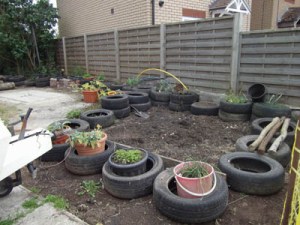
This garden, in Coxley, was built using reclaimed materials, at very little cost. A raised bed system is used as the local soil is a heavy clay, difficult to raise vegetables on. The growing area was created in stages over five years, using tyres as a retaining wall to enable easy expansion as soil became available.

It took quite a lot of soil to get a good depth in the vegetable beds. This was mainly reclaimed from building sites. Structure was added by mixing it with kitchen waste and manure. A home-made spray of comfrey, nettle and seaweed provided extra minerals. All the food is grown using organic methods and applying permaculture principles for low maintenance.

The garden was in a useful state of transition for the Open Day as the initial tyre layout had reached the final stage; the shape and size of the plot was now fixed. The tyres were being emptied and replaced by a low brick retaining wall. The higher stacks on the windy corner were still in place, demonstrating how versatile these temporary structures can be.  When the permanent wall is complete, willow hurdles will provide a wind break.

A new bed was being formed on the other side of the garden, using the old tyres to surround a patch of gravel ready to fill with soil. An edible green manure, such as rocket or cress will be planted there by the end of September

new-garden-13-3

Despite the cold rain setting in about lunch time, we had a dozen visitors over the course of the day, all of whom braved the outdoors to explore the garden. The plant identification game did have to be abandoned and the workshop became a lively kitchen table discussion, but all told, it was a good day!

Gardening for Resilience

Convert your garden into a year round food supply!

 Open Day at the Resilience Garden is on Sunday 15th September from 11 am to 5 pm at Harters Close in Coxley, Somerset. Entry is free as part of the Incredible Edible Somerset Open Gardens Day.

Visitors will have the opportunity to test their skills at plant identification and there will be a talk on community resilience at 2 pm, with demonstrations of useful and easy to learn crafts.

Save money, keep fit and be prepared

A visit to the supermarket, even for a pint of milk, rarely leaves you change from a £20 note, it seems. Shopping carefully on a budget, you’re better off only having to go there once a week! Having fresh vegetables to hand just outside your back door cuts down those extra shopping trips, as well as being healthier and involving no food miles at all.

Gardening is a good excuse to spend some time outside, taking gentle exercise. Modern no-dig techniques take much of the heavy labour out of maintaining a garden. Using home made organic fertilisers and recycling your food waste as compost reduce costs while companion planting and a healthy soil cut the need for expensive pest control products.

In the event of a national emergency, through extreme weather or hostile actions, our delicate and extensive food transportation network could be badly affected for some weeks. Rural areas could become isolated and dependent on limited stores. There may be no electricity, which would destroy frozen supplies and force reliance on tinned and dried food.

Growing your own would help your community through this, by providing a small but necessary amount of fresh produce with its vitamins and minerals.

Image

 Learning how to survive in the 21st century

The Resilience Garden is one of a series of projects designed by Elizabeth Walker, a teacher and writer with many years of experience in living ‘off the grid’. Her Resilience Wheel concept links all the factors necessary for a robust and sustainable community based economy into a single framework. No positive effort, however small, is wasted and everyone can do something straight away to bring a better world closer, while saving money and improving their quality of life.

She trains volunteer event stewards in emergency procedures during the summer, organises workshops around adapting traditional crafts to the modern world, and writes educational materials, articles and stories set in strange landscapes.

For more information on the Open Garden or on planned courses with Carymoor Environmental Centre and Somerset Skills and Learning, please follow this blog.


The Hemp Twine Project – Part One

One of my planned projects involves encouraging the sale of hemp twine to promote the local economy in Somerset. Everyone needs string. Hemp was once a major crop here, supplying huge quantities of rope for the Bristol shipping trade.

You can still see some of the long sheds where the ropes used to be twisted together from fibres.

Accordingly, after my summer adventures in the field, I set about ordering some hemp twine. Reluctant to create yet another customer profile for a possible single purchase, I called my chosen supplier and spoke to a friendly chap from the north of England.

I deplored the price of hemp twine, given the ease and low cost of hemp cultivation. He told me the sad tale of the decline of the natural fibre rope making industry faced with competition from oil based plastics. The hemp I was buying came from Egypt. Could I believe that unscrupulous sellers even tried to pass off jute fibre as hemp?

Uncomfortably aware that, although my grandfather would certainly have known the difference, I could be thus hoodwinked all day long, I moved the subject to purse nets. The hemp twine – the largest and cheapest reel I had found – was destined to make and repair these nets, commonly used for catching rabbits.

Alas, there was a sad story there too. Modern lads take no care of their hunting gear, but are content to stuff wet and muddy nets into a plastic sack at the end of a day. Left in this condition, even the spectacular ability of hemp to resist rot is overcome. Cheap imported plastic nets, however, can be abused endlessly.

Lads – do you realise that your careless lazy habits are having this impact? Take a minute or ten just to rinse out your nets and hang them up to dry before opening that can and slumping in front of the TV! Buy hemp purse nets or better still have some pride in your craft and make your own. There are instructions on the internet.

Hemp can and should be widely grown in this country. As well as fibre to replace imported oil based plastics, it yields nutritious seeds ideal for livestock feed. All it lacks is a market. Hundreds of new jobs could be created.

See how it’s all connected?

Start paying attention.